Welcome to Spooky Season, dear friends of The Green Farmacy Garden!
In our area, you’ve surely noticed nuts and leaves starting to blanket the ground and show off their transformative processes — whether decay or regeneration. These annual occurrences at our latitudes remind us of the cycle of life & death, and by extension, our own mortality. This year, we’ve all got many additional reminders as we track global news and navigate personal and communal tumult and upheaval close to home. How do you honor and integrate this most humbling aspect of life on our planet?
One way we’re all familiar with is the seasonal holidays and scary decorations and activities, folks creating physically safe but psychologically upsetting art for and with each other, turning the adrenaline of fear into excitement and exhilaration.
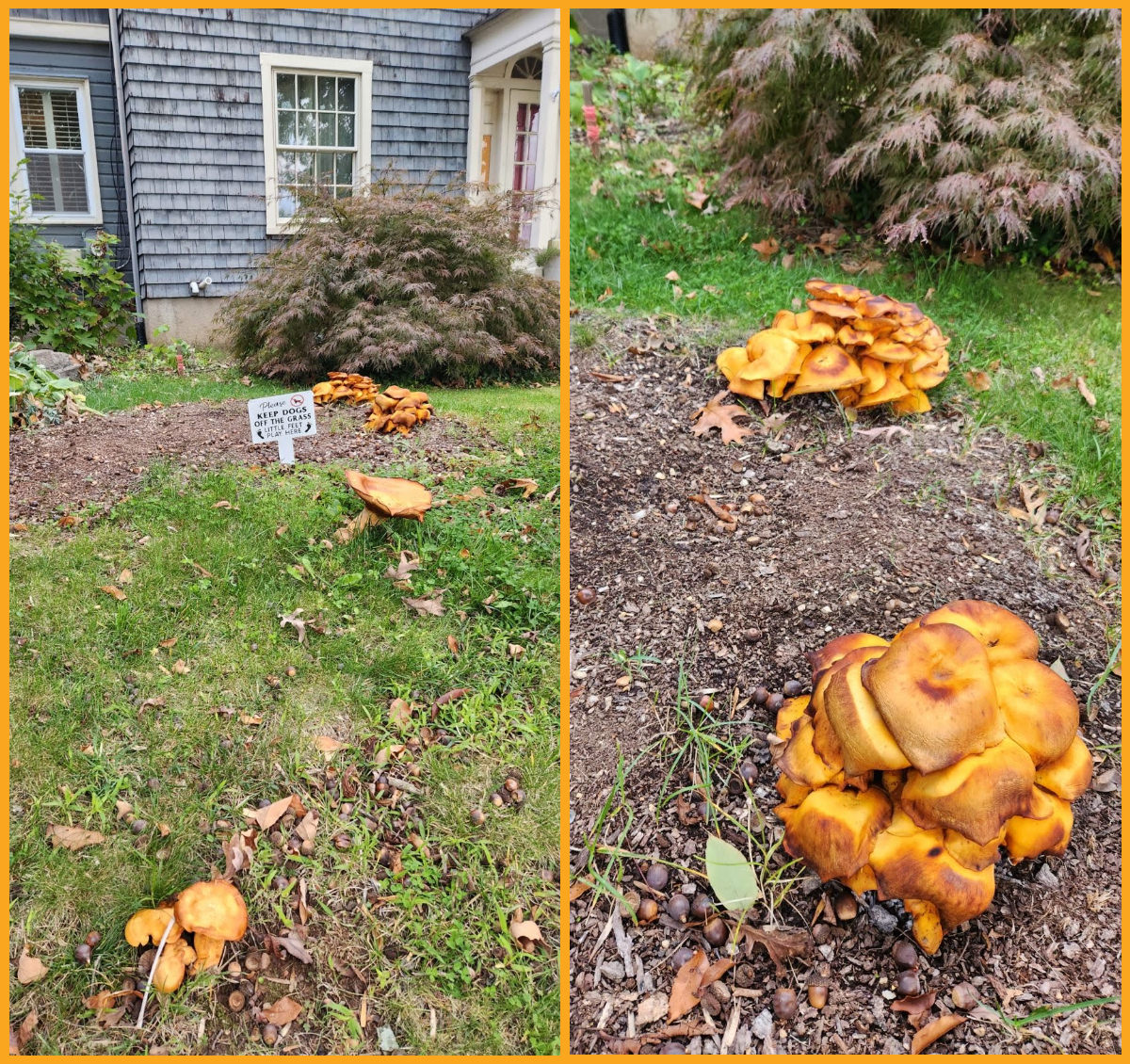
I came across these Jack-o’lantern (Omphalotus illudens) mushrooms on a neighborhood walk last October, and they took my breath away, striking me as the coolest & best home decoration I’d yet seen.. The species is so-named because their gills are actually bioluminescent — they glow in the dark just like our carved pumpkins, while being themselves bright orange and producing impressively big clusters. At first I thought these residents had Fake lawn ornament versions of Jacks that would glow in the dark at night!! Like the macabre skeletons, reapers, and zombies of our holidays and art, these and other fungi can symbolize the universal truth of death and decay that feed new life: Jacks’ mycelium break down and consume dead wood and tree roots, cycling a tree’s life into its own and eventually forming mushrooms to spread spores to new food sources.
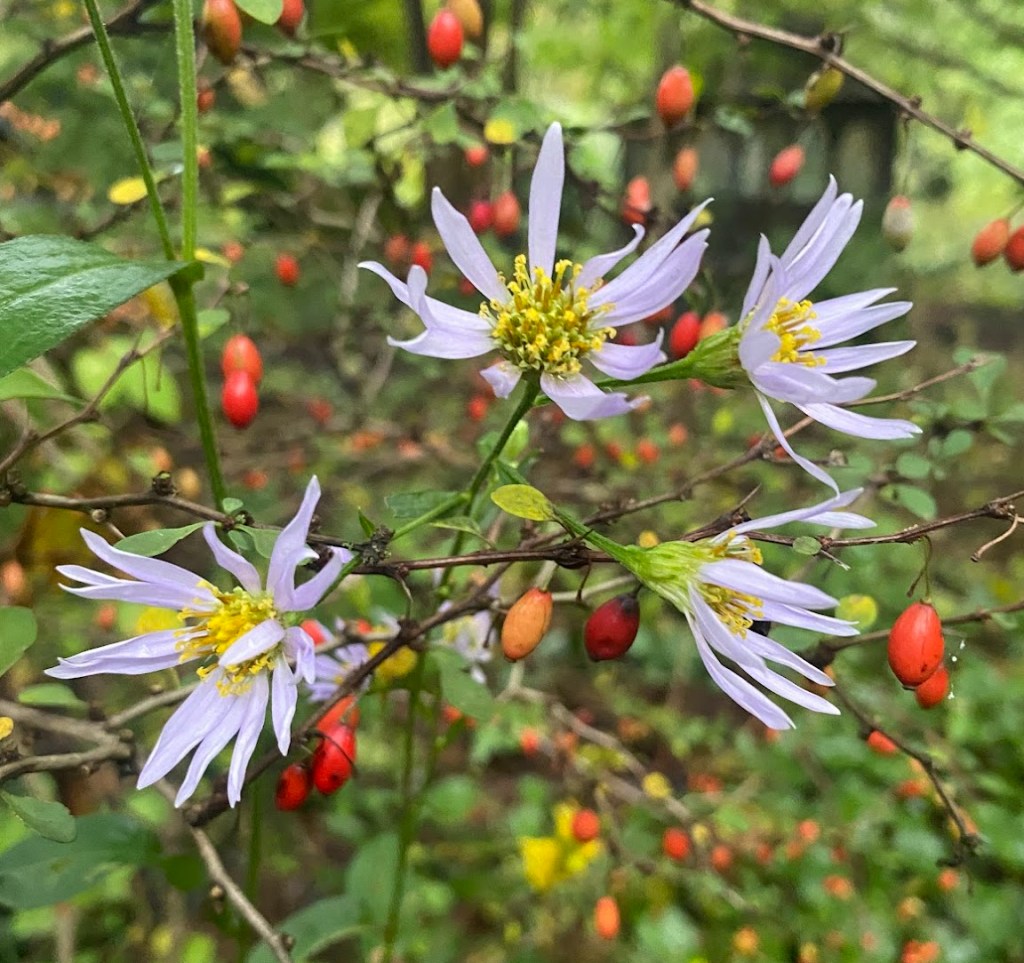
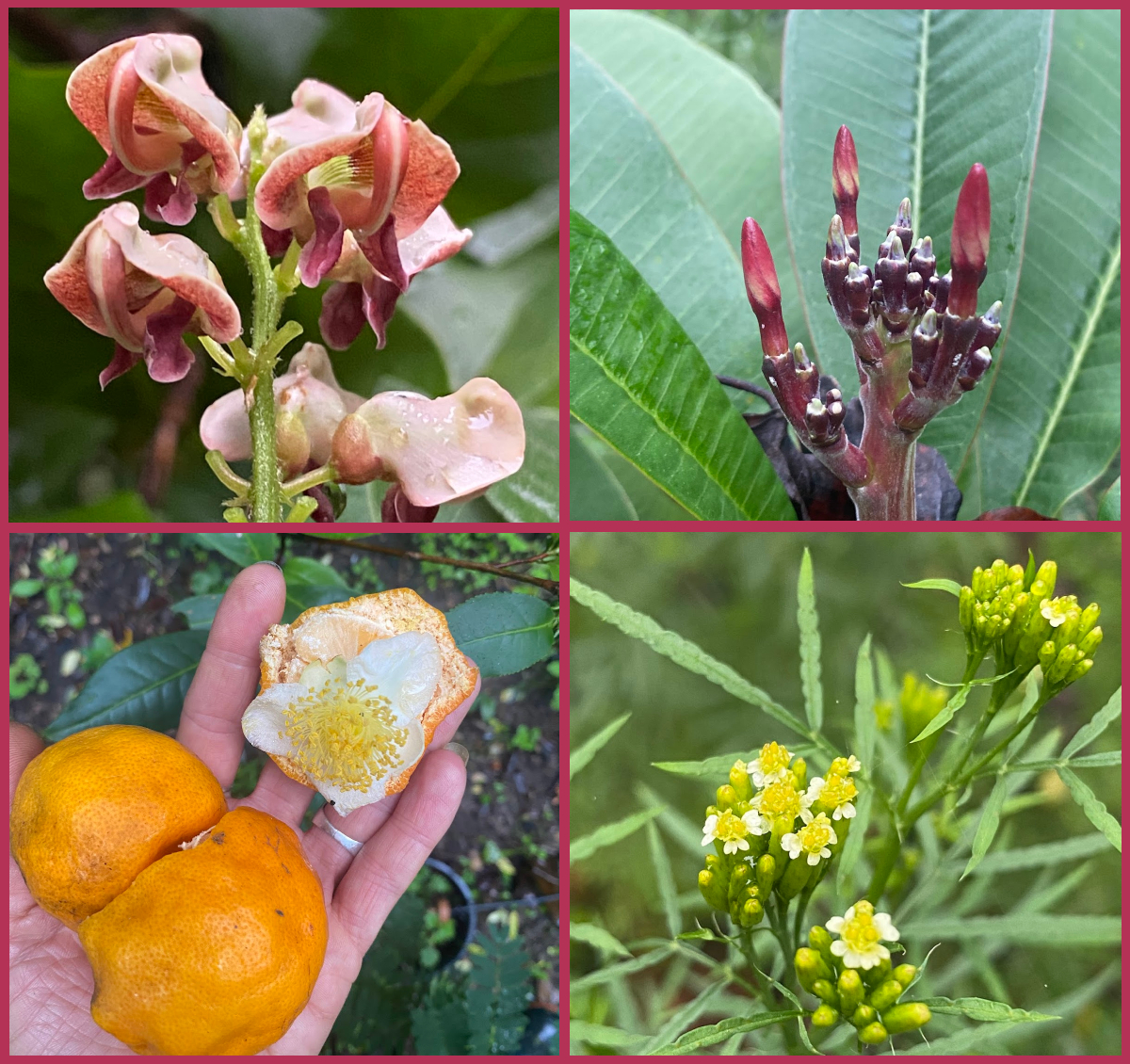
Though we’ve clearly turned the corner to fall, there’s still plenty of living going on in the garden. A few species like the Tatarian Aster (Aster tataricus, in the top photo above with Berberis vulgaris berries), and below, clockwise from top left, Hopniss/ Ground Nut (Apios americana), Plumeria (Plumeria sp.) budding for the first time during my GFG tenure!, and Huacatay (Tagetes minuta), and citrus (Citrus spp.) are still blooming! Apparently other Hopniss in the area have already set pods, while ours are still blooming and I’ve never seen them set pods. It makes me suspect we may have the triploid variety.
We weren’t sure how many bugs would be about during our late September Insect Inspiration/ Bug ID workshop, but our group found plenty! Dragonflies (maybe Common Green Darner, Anax junius) around the pond, leaf-footed bugs (family Coreidae, below bottom right) and spittlebugs (superfamily Cercopoidea) on the Huacatay, a jumping spider (family Salticidae, below top right), a Potter wasp (Eumenes fraternal, below, top left), Milkweed bugs (Oncopeltus fasciatus), Lady beetle nymphs and mating Lady beetles (family Coccinelidae, below bottom left), caterpillars, moths, bees, and more!
In addition to the offerings at GFG, CEI hosts weekly Plant and Produce sales at Freetown Farm on Saturdays, offers monthly New to CEI tours there, and operates a variety of experiential education programs, which you can explore on the Programs page of the website. The full CEI event calendar is available on the website.
The silent auction for our annual Harvest Gala is live and open for bidding for the next two weeks, closing on October 17th at the end of the Gala. This is a fun way to score some great trips, tickets, tastings, and treasures while supporting our mission to cultivate communities where people and nature thrive together. Check out the “Duke Bundles” containing selections of Jim and Peggy’s work!
When you’re ready to make your bids, you will be asked to register with Winning Bidder, the platform hosting the auction. Our entire community is invited to participate in the silent auction, even if you don’t attend the Harvest Gala!
And while space is filling up for the Gala itself, our new venue can accommodate quite a crowd & we’d love for our Garden community to meet the larger community supporting CEI. Join us for the fun! Here’s a taste of last year’s Gala:
There’s so much going on this month! Please explore our public event offerings and engage in whatever educational opportunities inspire you! The full CEI event calendar is available on the website.
My best, Veri
Jumping spider and potter wasp images courtesy of garden friend Reynie Brown; Aster/ Berberis and featured plant photos by Annie-Sophie Simard; Gala photos by CEI staff??; all others by Veri Tas.
Happy September, dear friends of The Green Farmacy Garden!
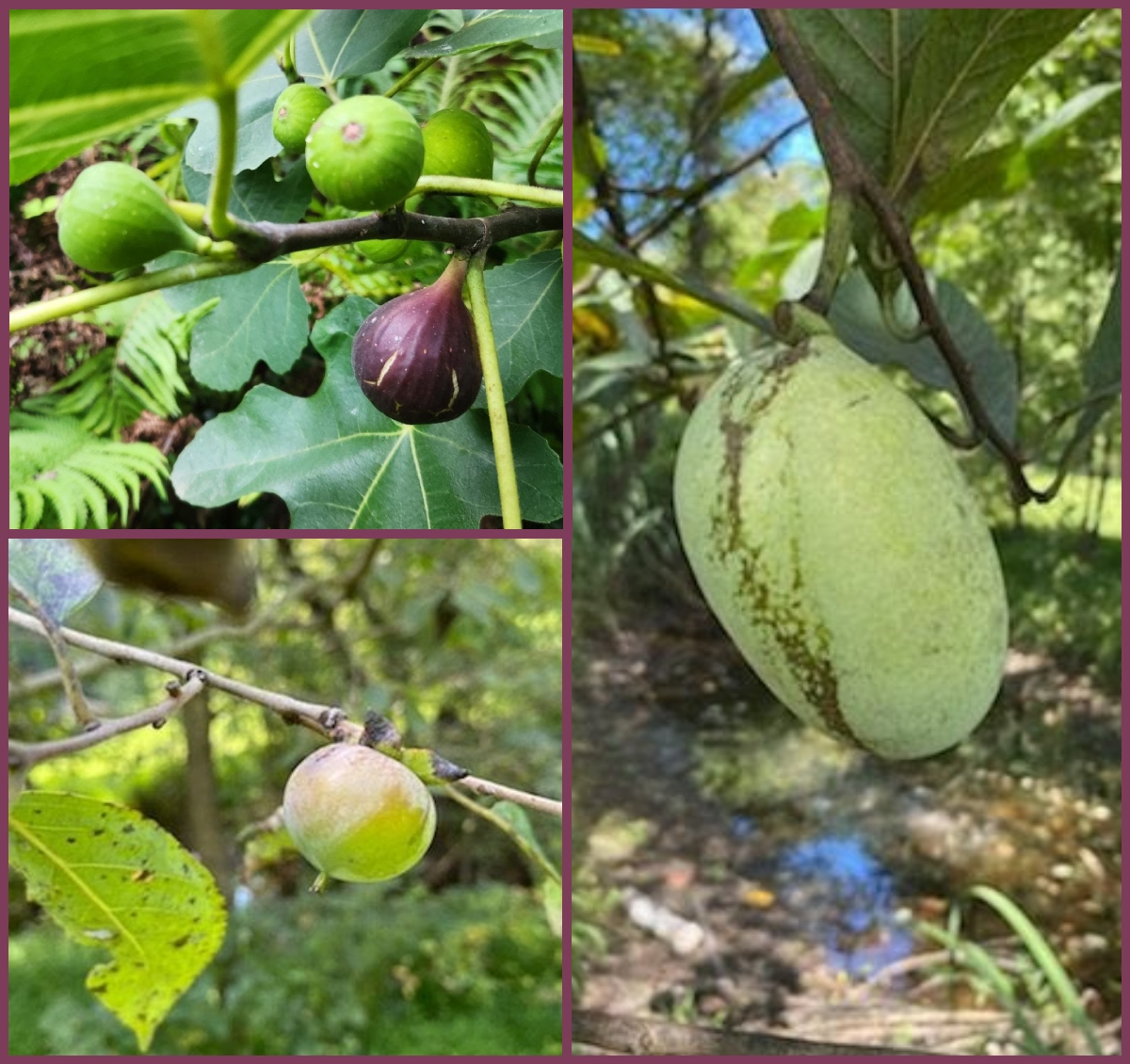
And, just like that! Now we’re winding down summer and, like the plants and animals, beginning to shore up for winter. We’re enjoying ripe figs (Ficus sp) (below, top left) and watching persimmons (Diospyros virginiana) (bottom left) and passionfruits (Passiflora incarnata) develop. Most excited for the imminent Peterson Pawpaws (Asimina triloba) (bottom right) maturing on trees generously donated years ago by friend of the Garden Mike Schenk!
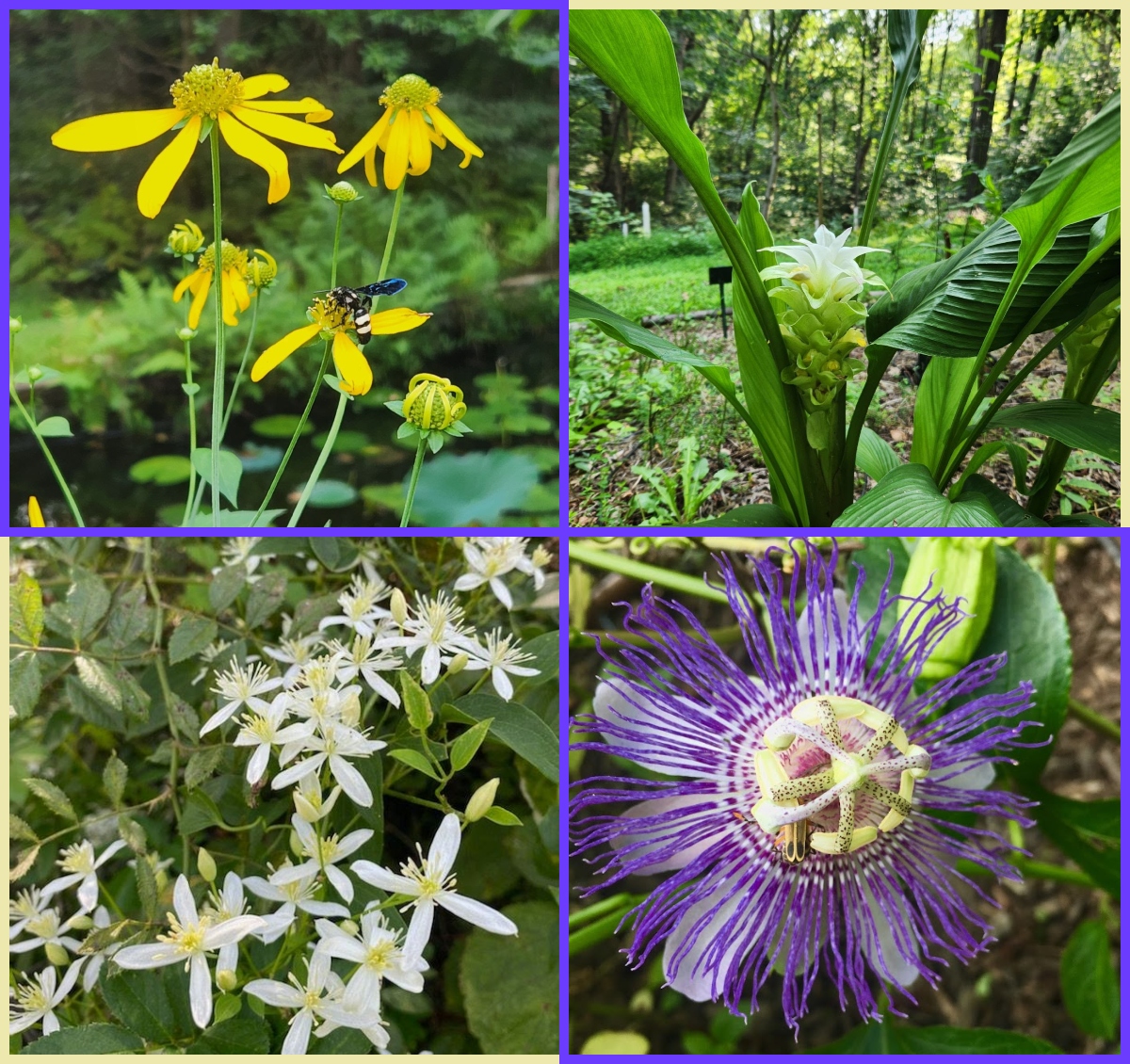
Garden show, of course, is down to the late-bloomers like Goldenrod (Solidago spp), Sochan (Rudbeckia laciniata) (below, top left) and other asters, punctuated here and there by mind-bending Passionflowers (Passiflora incarnata) (bottom right), and the Turmerics (Curcuma longa) (below, top right) old enough to bloom! Beyond the Garden, rambling over bamboo, mulberry, bittersweet, and more along the driveway where it’s hard to reach and manages to access the sun it needs, the heavenly sweet-scented Asian-native Sweet Autumn Clematis (Clematis terniflora) (bottom left) has also begun its reproductive riot.
The heron mentioned last month (probably) has been returning to stalk the pond, and we’re exploring options to deter them.. though I adore seeing them, and their medicine has blessed all the staff here at times we quite needed it, we want to protect the fish and frogs our pond supports. We’d welcome contributions of expertise or materials from anyone who’s successfully accomplished a mission like this before!
Other wildlife we’ve enjoyed spotting include the local wild turkey (Meleagris gallopavo) flock passing through (below, top right), an American Toad (Anaxyrus sp) (below, top left), a grasshopper (bottom left)? I’m unable to identify, and a flashy insect.. maybe a Net-Winged Beetle (Calopteron sp)? (bottom right). Hopefully our “Bug Diversity” workshop later this month will help me (and others) with these IDs! And thanks to our Outreach and Restoration Grant from Chesapeake Bay Trust, we’ve secured several wildlife cameras that we hope will soon enable us to provide you with better quality images of more faunal diversity!
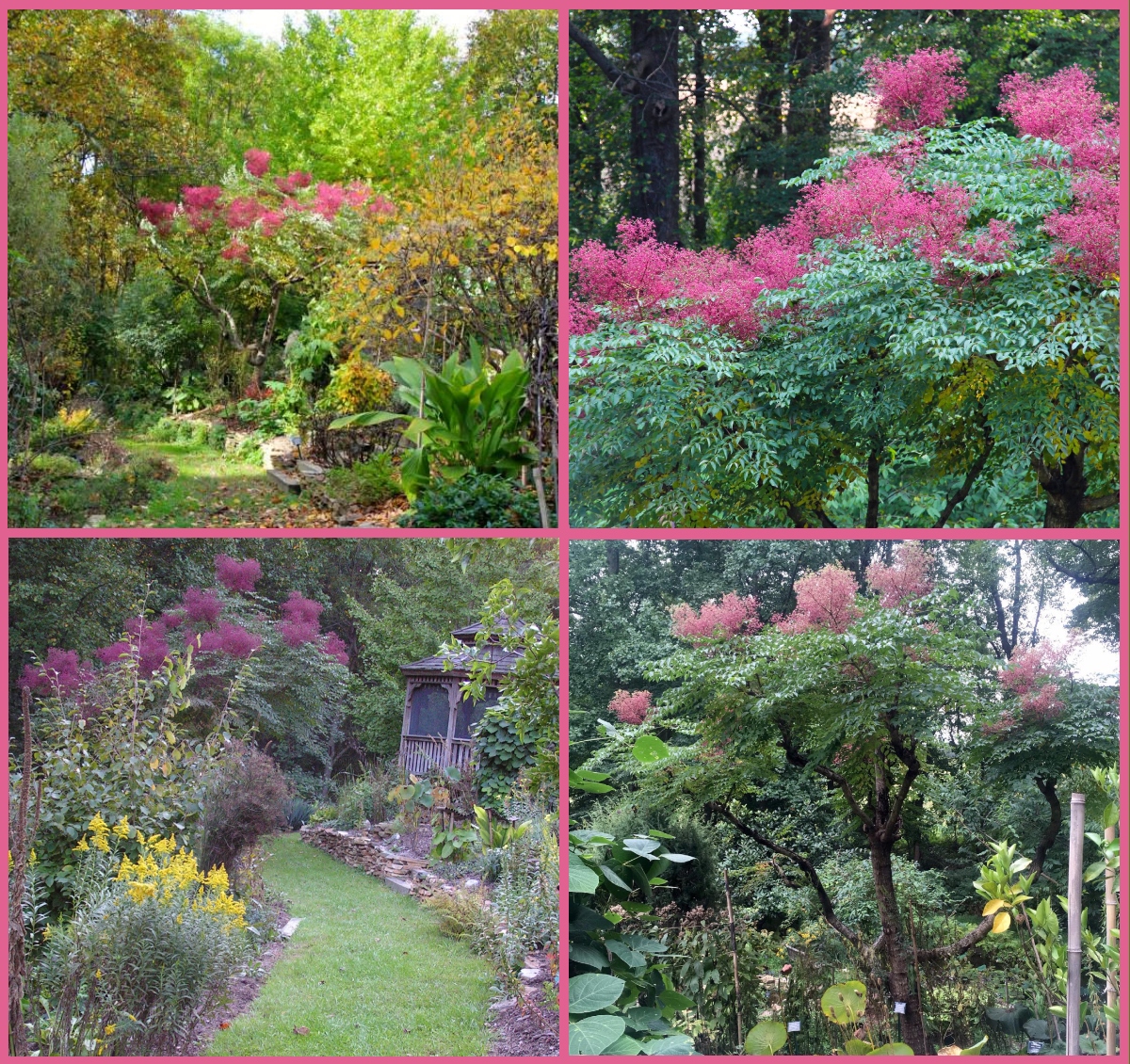
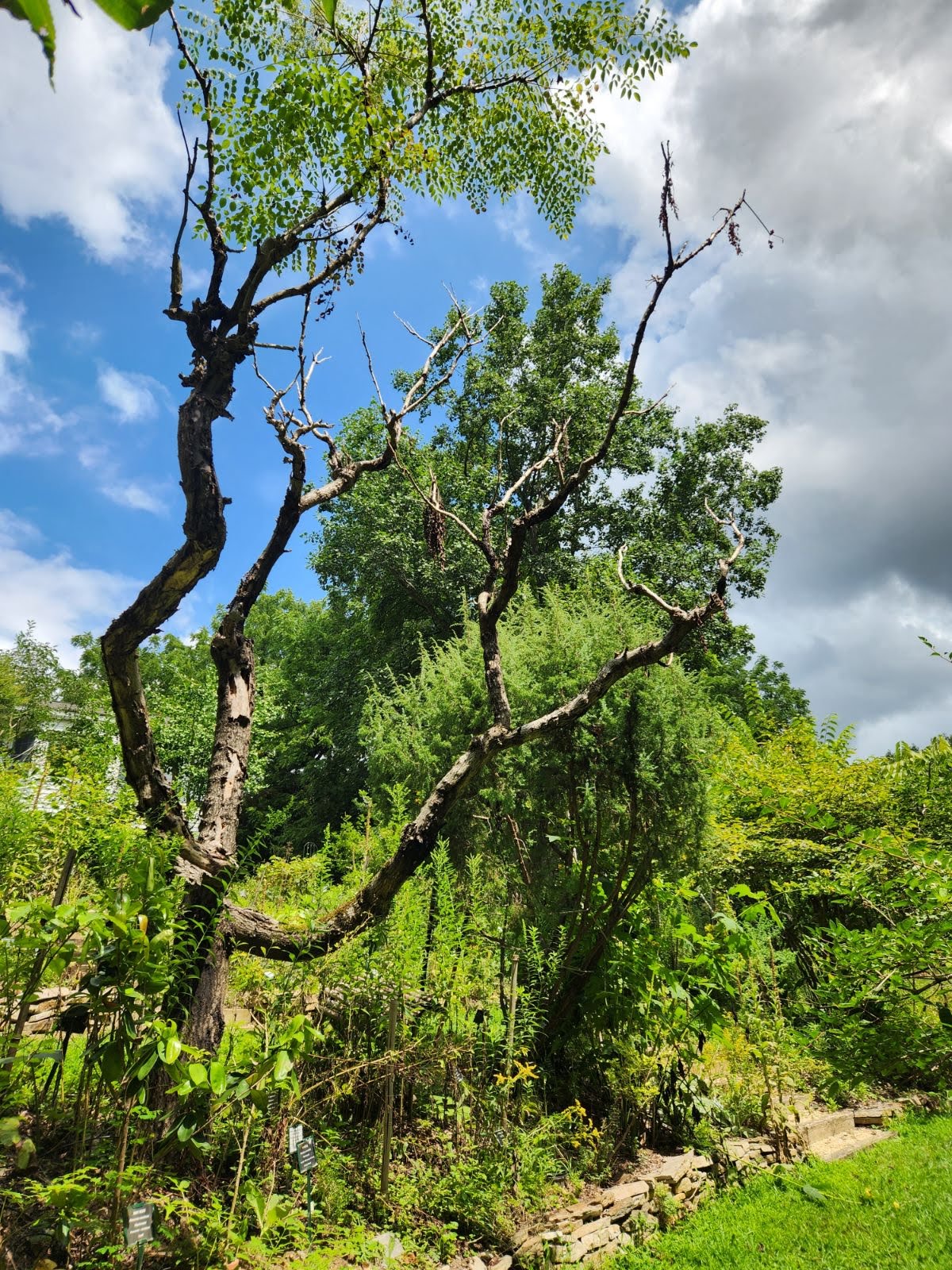
We sadly watched the leaves and flowers wilt and brown on branch after branch of the stunning Devil’s Walking Stick (Aralia spinosa), who’d provided a central sculptural statement by the stairs in Terrace C and an all-you-can-eat buffet for buzzing multitudes of pollinators for many years. Pictured below in 2014 (top left), 2016 (top right), 2017 (bottom left) and having begun its decline in 2019 (bottom right).
Research confirms my own suspicion based on observing wild populations that this species tends to form colonies of straight, largely branchless trunks. Plants with a colonizing habit, that spread by underground runners (rhizomes), are among the most challenging to deal with in the Garden: not only are they hard to keep track of and hard to remove, digging them out can cause disruption to other plants’ roots and to the graded terrace surface, resulting in increased erosion risk; as well as adding pressure to the aging rock walls holding up half of each Terrace! So I’ve long been somewhat awestruck with gratitude for the unique growth habit of our Aralia spinosa specimen, with its bold branching and non-evident root spreading.
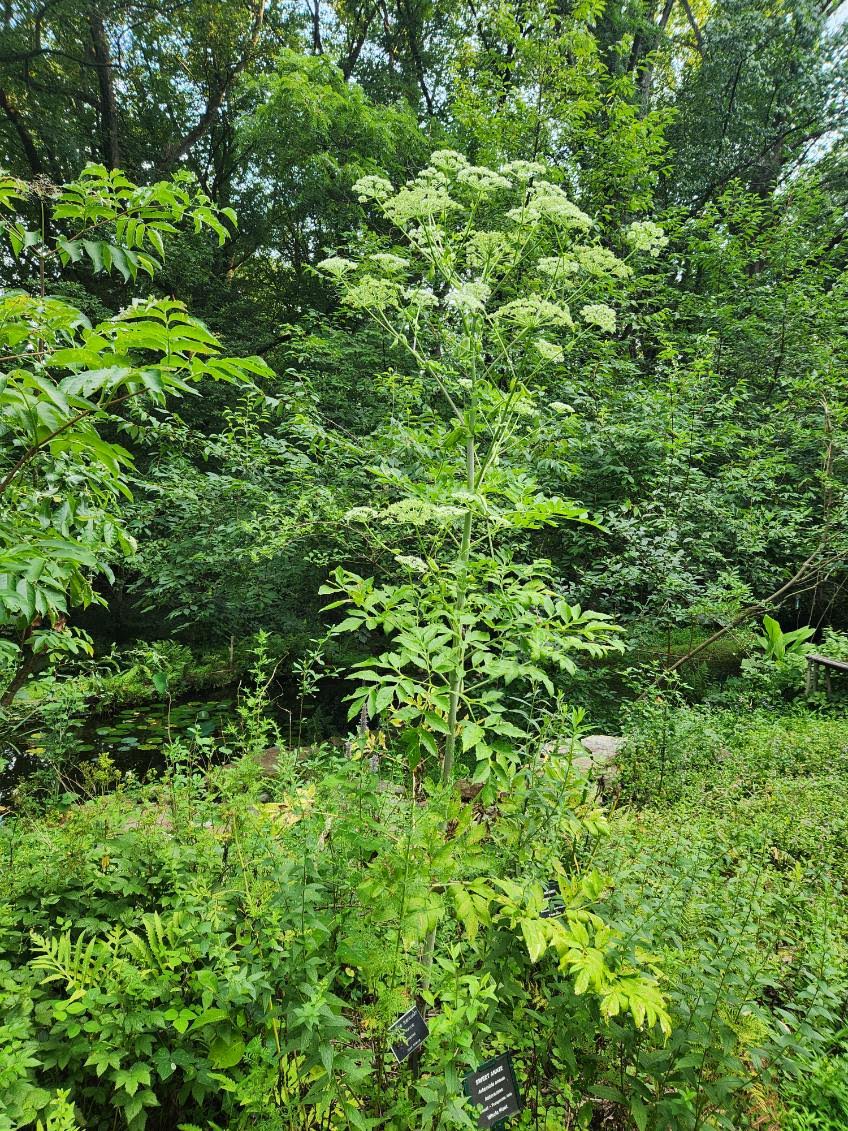
When I joined The Green Farmacy Garden team in 2019, the Prickly Ash (Zanthoxylum americanum) tree that used to grow in Toothache alongside the Devil’s Walking Stick (and shade the Giant Butterbur (Petasites japonicus) in the adjacent Headache plot) had recently died back and only remained as a stump, but since then we’ve watched many sprouts come up throughout the plots and currently, one seems poised to replace the former specimen. So when the last leaves of the Aralia (below) withered, I went around checking all the shoots in the area to ensure they were Prickly Ash and not Devil’s Walking Stick.
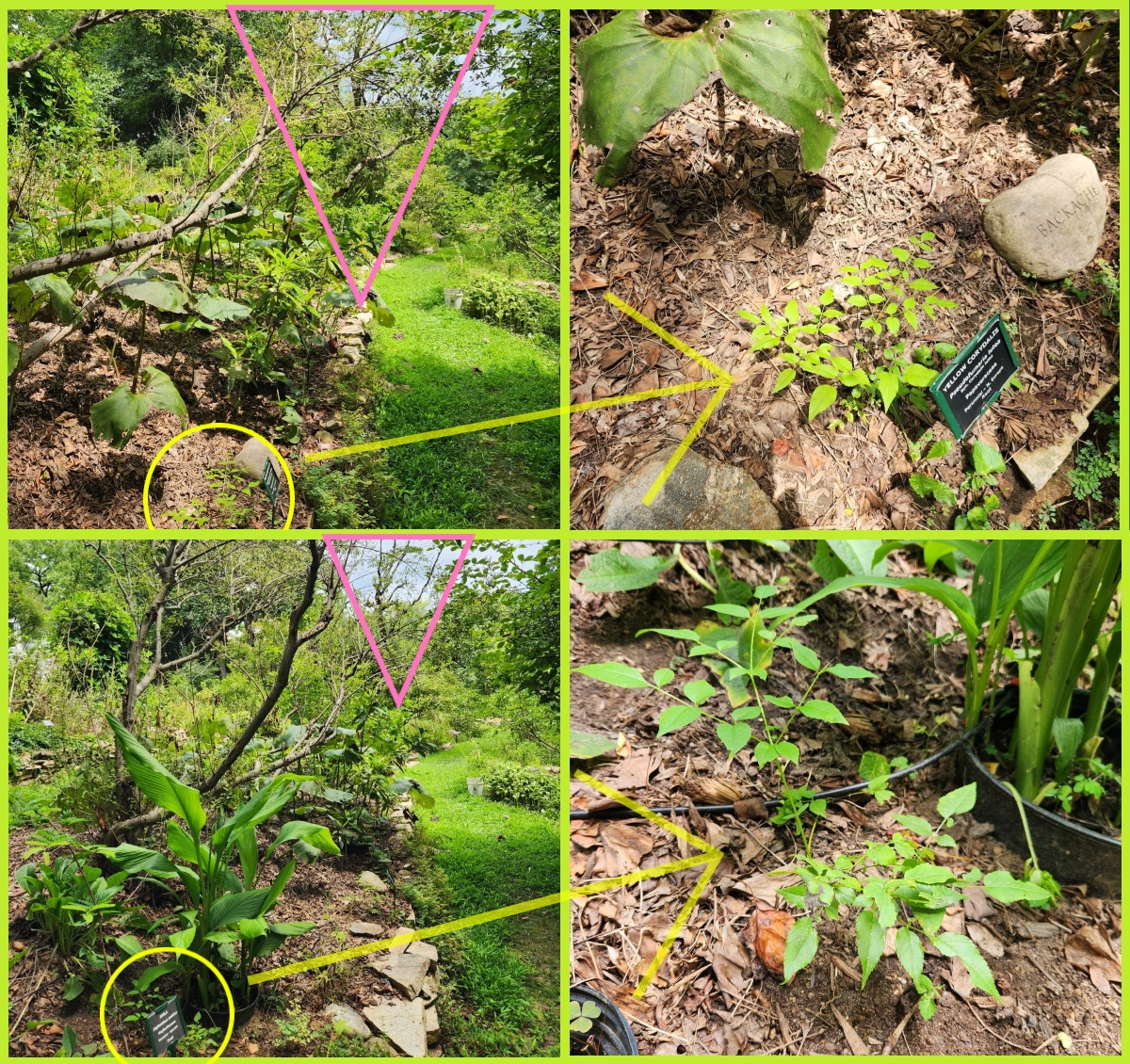
But to my utter delight, I discovered that many ARE in fact Aralia shoots popping up, from quite distant roots. I found a few amidst the Butterbur, but then was amazed to find the one pictured below (top left and right) under the Willow (Salix integra?) 3 plots down in Bursitis.. and then the one past the Willow (below, bottom left and right), between Turmeric (Curcuma longa) and Amla (Phyllanthus emblica) moving on towards Bronchitis! The original Aralia is highlighted in pink below, ever more distant!
If you zoom in, you might be able to see at top right the clinching characteristic letting me know these are Aralia and not Zanthoxylum shoots. Prickly Ash has pinnately compound leaves (leaflets are arranged around the leaf-stalk in a pattern reminiscent of a feather), while Devil’s Walking Stick has the largest leaf of any temperate tree in the continental U.S. (according to Wikipedia article), up to 4′ long! and with a multiply compound structure, consisting of pinnately arranged leaflets which themselves are composed of pinnately arranged leaflets.
Please explore our public event offerings to touch and vibe with this amazing plant yourself, and engage in whatever educational opportunities inspire you!
In addition to the offerings at GFG, CEI hosts weekly Plant and Produce sales at Freetown Farm on Saturdays, offers monthly New to CEI tours there, and operates a variety of experiential education programs, which you can explore on the Programs page of the website. The full CEI event calendar is available on the website.
Tickets are selling fast for our October 17 annual Harvest Gala fund-raising event, but our new venue can accommodate quite a crowd so there’s plenty of room for you and your crew. Come on out to meet, mingle, and nosh with a lot of our staff, learn about the various program offerings, bid on silent auction items, enjoy musical entertainment, and get a big picture sense of the impact CEI’s work makes in our community of place.
My best, Veri
Pawpaw, persimmon, clematis, turkey photos by Annie-Sophie Simard; mantis and spider by Matthew Jacobsen; Io moth by Julie Biedrzycki; all others by Veri Tas.
Are you staying cool this summer, dear Friends of The Green Farmacy Garden? (or warm this winter, for our friends in the Southern hemisphere!)
July brought a couple rains, and the record-breaking sweltering heat relented to more normal height-of-summer temps, but these recent weather extremes are really putting the plants through their paces! Despite the challenges to local flora, we’ve enjoyed many encounters with the biodiversity the Green Farmacy Garden property and region hosts and supports. We’re grateful for our bird-enthusiast friend Terri adding The Green Farmacy Garden as an eBird hotspot, so everyone can peruse the many bird species observed here!
Bunnies and groundhogs have been much more visible than many previous years, though we’ve seen fewer snakes. Annie-Sophie had to chase off a Great Blue Heron (Ardea herodias, below) who was gorging on frogs in the pond, and Veri and friend surprised a doe in the woods who trumpeted at us repeatedly while paralleling our path. Wonder if she was calling a fawn, or warning us to keep distance?
Here’s a beautiful example of why we NEVER pull (weed) a plant we can’t identify from Jim Duke’s garden.. none of the gardeners recognized the plant below (left), which looks very similar to Ginger (Zingiber officinale) but has unscented foliage, and is growing unprotected from the ground unlike our Ginger pots that all have to overwinter indoors. An internet resource suggested Myoga (Zingiber mioga), or Japanese Hardy Ginger, which jogged a faint memory for me of having brought some rhizomes of an exciting plant from local textile artist/ weaving legend Louise B. Wheatley‘s garden that I in no way expected to take. Looking up Myoga, I got excited and decided that was likely our plant, and then a few days later noticed this bloom (below, right), which clinched the ID. The young shoots and flower buds of Myoga are used culinarily, and I can’t wait to try them as the patch continues to flourish! I planted them in the Cancer plot, because the plant and its constituents have been researched for anti carcinogenic properties.
One of the most impressive biennials that self-sows in the Garden is Bai Zhi (Angelica dahurica), an herb with its own Traditional Chinese Medicine uses that is mainly grown in the GFG to represent Dong Quai (Angelica sinensis), more because of aesthetic similarities than medicinal application. This plant seeds so abundantly that I began dead-heading it aggressively a couple seasons back, but then we missed a year with an impressive (I mean they probably clear 8′ tall, despite the internet telling me 1-2 meters) specimen and I was afraid I’d damaged the genetics, so very relieved and joyful with the couple stunners we’ve got this year. Watching their new axial leaves uncurl from the sheath of an older leaf (below, top left) is one of my favorite annual delights along with the dew on new Lady’s Mantle (Alchemilla mollis) leaves and the emergence of baby Mayapple (Podophyllum peltatum) shoots that look like button mushrooms. Below top right is the season’s tallest Bai Zhi, and at bottom, near frame-center is a Black Swallowtail (Papilio polyxenes) caterpillar chowing down on its blooms.
We’ve always got a stunning array of insects visiting the diverse plants at the garden, though this year there’s been less in-your-face butterfly predation as our incredible venerable Devil’s Walking Stick (Aralia spinosa) seems to have reached the end of its lifespan. Its blooms attracted a buzzing swarm of pollinators each year, and one year Bald-Faced Hornets (Dilochovespula maculata) were just picking off butterflies right and left as they nectared up there. We had a [very] few Spotted Lanternfly (Lycorma delicatula) nymphs on the Grape vines (Vitis sp.) earlier this season; and we’ve seen a few live adults scattered about, almost as many adult remains, and plenty of exuviae (shed skins of nymphal stages); but last week I came across the densest cluster (below, top left) I’ve yet seen onsite, chilling on our Prickly Ash (Zanthoxylum americanum).
** non-party-line interlude! If you’d feel better with “permission” to stop killing bugs, and training kids to kill bugs, check out this humane piece by Maryland’s “Humane Gardener” Nancy Lawson, this summary (or there’s plenty of other summarizing articles, and the paper itself) of the Penn State research project whose lead author said “if you’re a homeowner and you have large trees on your property and you have lanternflies on them, I don’t think you should worry about it.” and “Our study is the first to look at the long-term impacts of feeding pressure on northeastern hardwoods, and our results suggest that we are unlikely to see big impacts on the growth of trees.” There’s also a lot of interesting discussion here (pretty far downthread, tbh) among mostly amateur naturalists, if you’ve got a lot of time to read. You can also keep your own eyes peeled for dead lanternflies or those being eaten by predators, or check out this article on who’s eating them, and the iNaturalist collection of public observations. *NB: I’m not willing to moderate a flame war, or any debate on the subject, here, really => comment submissions on the whiny-outraged-you’re wrong spectrum won’t be approved. There’s a whole wide internet where you can state your own beliefs or find folks to argue with, including some of the links above. **
Some other insects spotted this month include, below, clockwise from top right: Spiny Assassin bug nymph (Sinea sp.) on Anise Hyssop (Agastache foeniculum); Luna moth (Actias luna) hind wing pair found in grass along the woods; Bug eggs I find every year on Spearmint (Mentha spicata) — the closest I’ve been able to get is Family Coreidae (Leaf-Footed Bugs)
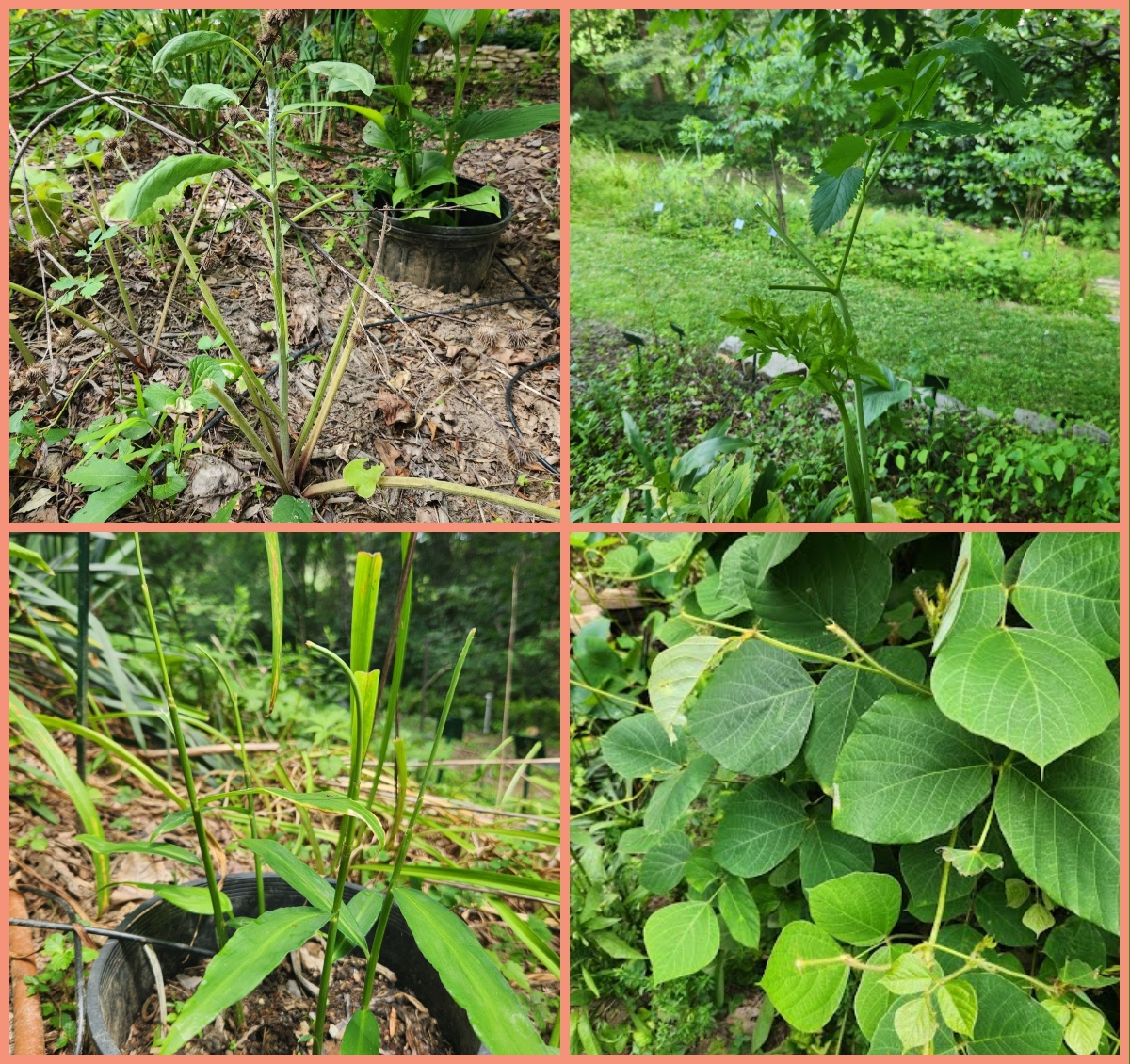
For all of you who eagerly clicked here for the latest on who’s getting hardest hit by megafauna herbivory (lol) the update is several natives whose status I know from their location in the Garden but whose actual identity I wasn’t able to confirm for this publication, and plenty of exotics. Below, clockwise from top right: Burdock (Arctium sp.), Bai Zhi (Angelica dahurica), Kudzu (Pueraria sp.), and Ginger (Zingiber officinale).
In these shots you can see nibbled stalks of, left, native Dogbane (Apocynum cannabinum) and non-native Mimosa/ Silktree (Albizia julibrissin) suckers; right, native Pinkroot (Spigelia marilandica) and non-native Valerian (Valeriana officinalis).
As always, please explore our public event offerings to experience the intrigue in person!
In addition to the offerings at GFG, CEI hosts weekly Plant and Produce sales at Freetown Farm on Saturdays, offers monthly New to CEI tours there, and operates a variety of experiential education programs, which you can explore on the Programs page of the website. To celebrate Freetown Farm’s 5th Birthday, we’re hosting a “Food by Freetown” event featuring a menu prepared with ingredients grown onsite, with a screening of the film “Common Ground” on August 22. The full CEI event calendar is available on the website.
Once again, if it’s within your means, we’d love for you to join us for our October 17 annual Harvest Gala fund-raising event, where you can meet, mingle, and nosh with a lot of our staff, learn about the various program offerings, bid on silent auction items, enjoy musical entertainment, and get a big picture sense of the impact CEI’s work makes in our community of place.
My best, Veri
All photos the creative works of Veri Tas, except Heron and Myoga flower by Annie-Sophie Simard
As locals will have noticed.. it’s been a sweltering start to summer here in Maryland! Good bit of dry, good bit of soupy humidity, but consistent heat throughout. Many plants are struggling, though a few seem delighted, but I’ll go into all that in a little. First I invite you to celebrate with us our first ever kid-centric public event, Children’s Day Extravaganza hosted on June 9. Here are some highlights:
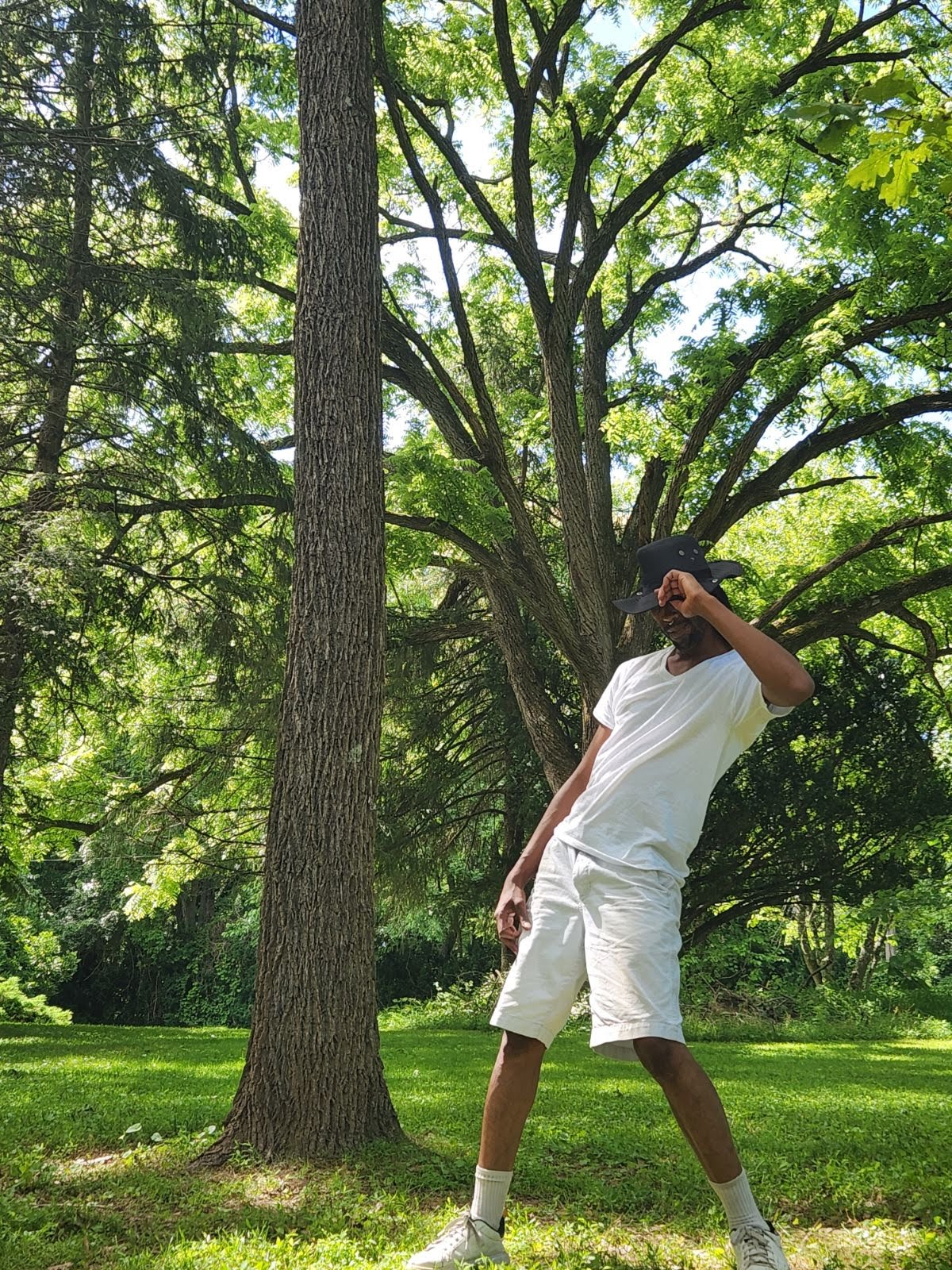
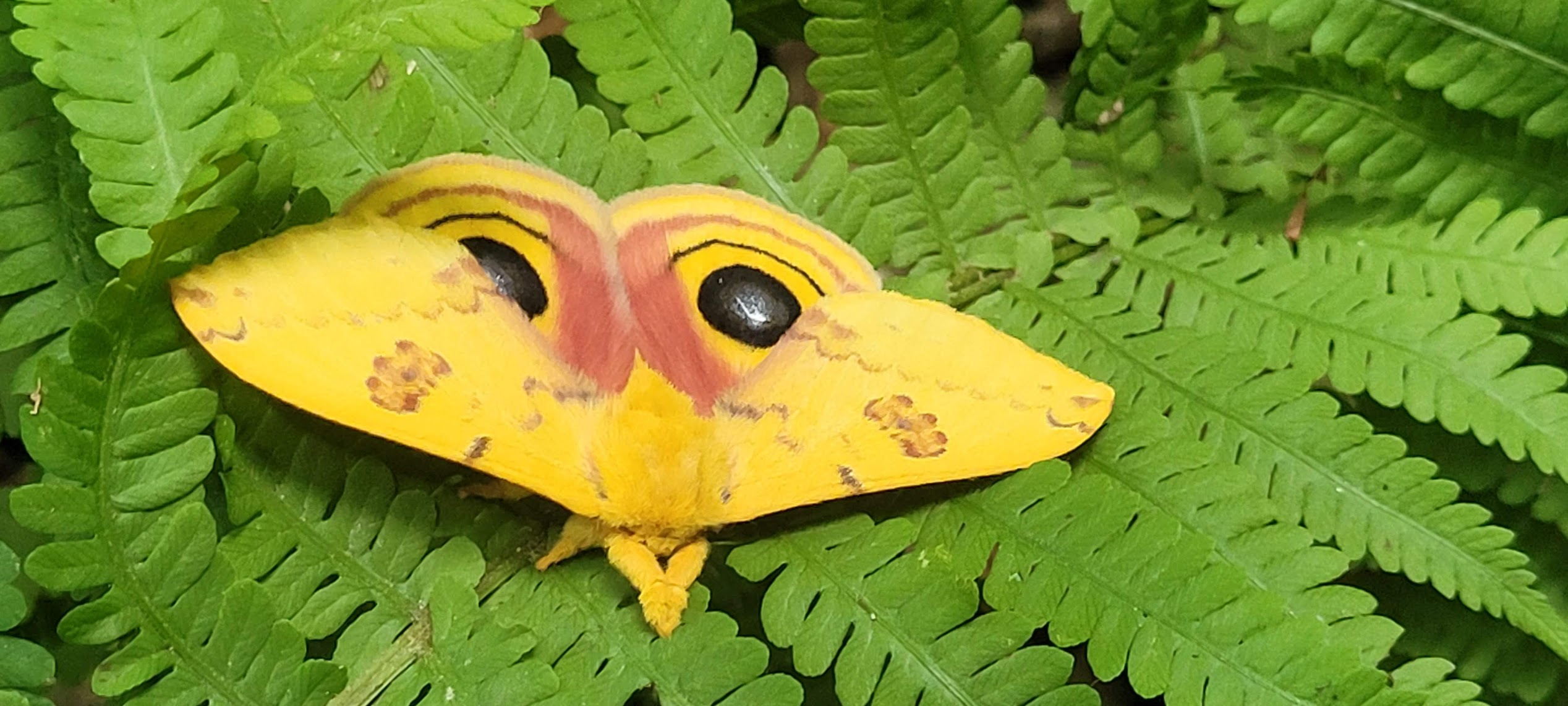
Another dream come true: kids in the Black Walnut tree!Many children chose to stretch themselves by handling creepy-crawlies during guest educator Julie Biedrzycki‘s Bug Hunt.Somatic experiencers enjoyed guest educator Talbolt Johnson‘s guided movement exploration against the stunning backdrop of another regal Black Walnut.This Io moth (Automeris io) was the star of the Bug Hunt show, chilling spectacularly on an Ostrich Fern (Matteuccia struthiopteris) down by the stream while families oohed and aahed, observed and photographed.
Staff have wanted to share the wonders of the Garden, grounds, and biodiversity here with more children for ages, and thanks to the management, structures, resources, and practices of the Community Ecology Institute (CEI), of which the Garden is now a part, we were able to give it a go with this initiatory offering. Over 25 families joined us on that perfect Sunday and explored the biota of every stretch and edge of the property.
CEI’s mission is cultivating communities where people and nature thrive together. In addition to the expanded offerings here at The Green Farmacy Garden, CEI offers a variety of innovative, meaningful experiential education programs for people across the lifespan, which you can explore on the Programs page of the website. Some activities with A Community of Families in Nature are still open for summer registration, and fall registration will open mid-July.
A fun way to support and connect with CEI as a whole, if you’ve been looking for such an opportunity, would be to join us for our October 17 Harvest Gala fund-raising event, where you can meet, mingle, and nosh with a lot of our staff, learn about the various program offerings, bid on silent auction items, enjoy musical entertainment, and get a big picture sense of the impact CEI’s work makes in our community of place.
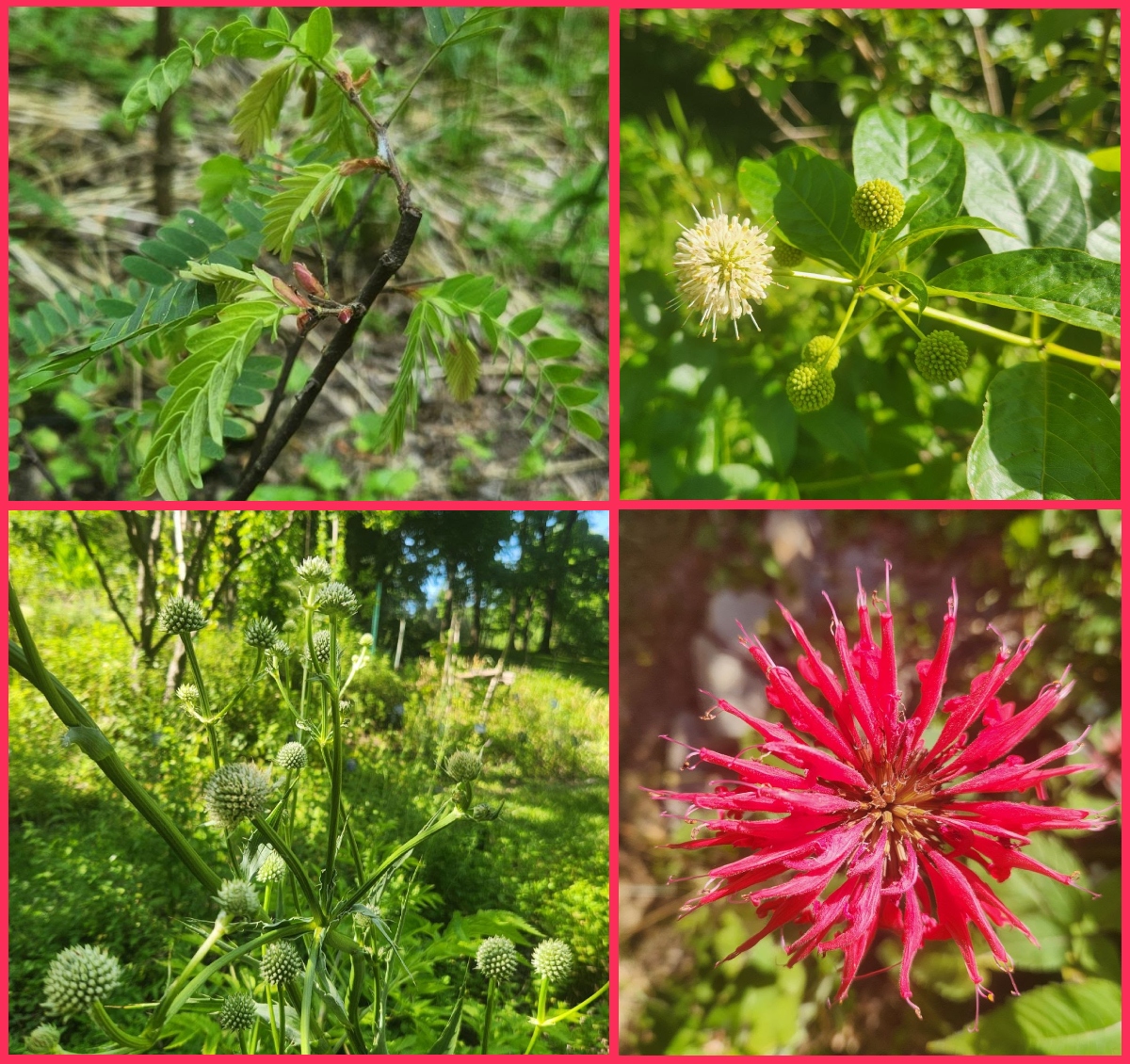
And now, back to our regular Garden update! We’ll open with some of the delighted species I mentioned, below clockwise from top right: Amla (Phyllanthus emblica), happily pushing out perfect new leaves despite the recent drought, through which even our regular drip irrigation regime couldn’t keep a lot of the plants sufficiently hydrated; native Buttonbush (Cephalanthus occidentalis) looking lush in the moist and shady Immunity plot; native Beebalm (Monarda didyma) putting on its own fireworks display; and the first chaotic bloom of our Rattlesnake Master (Eryngium yuccifolium)
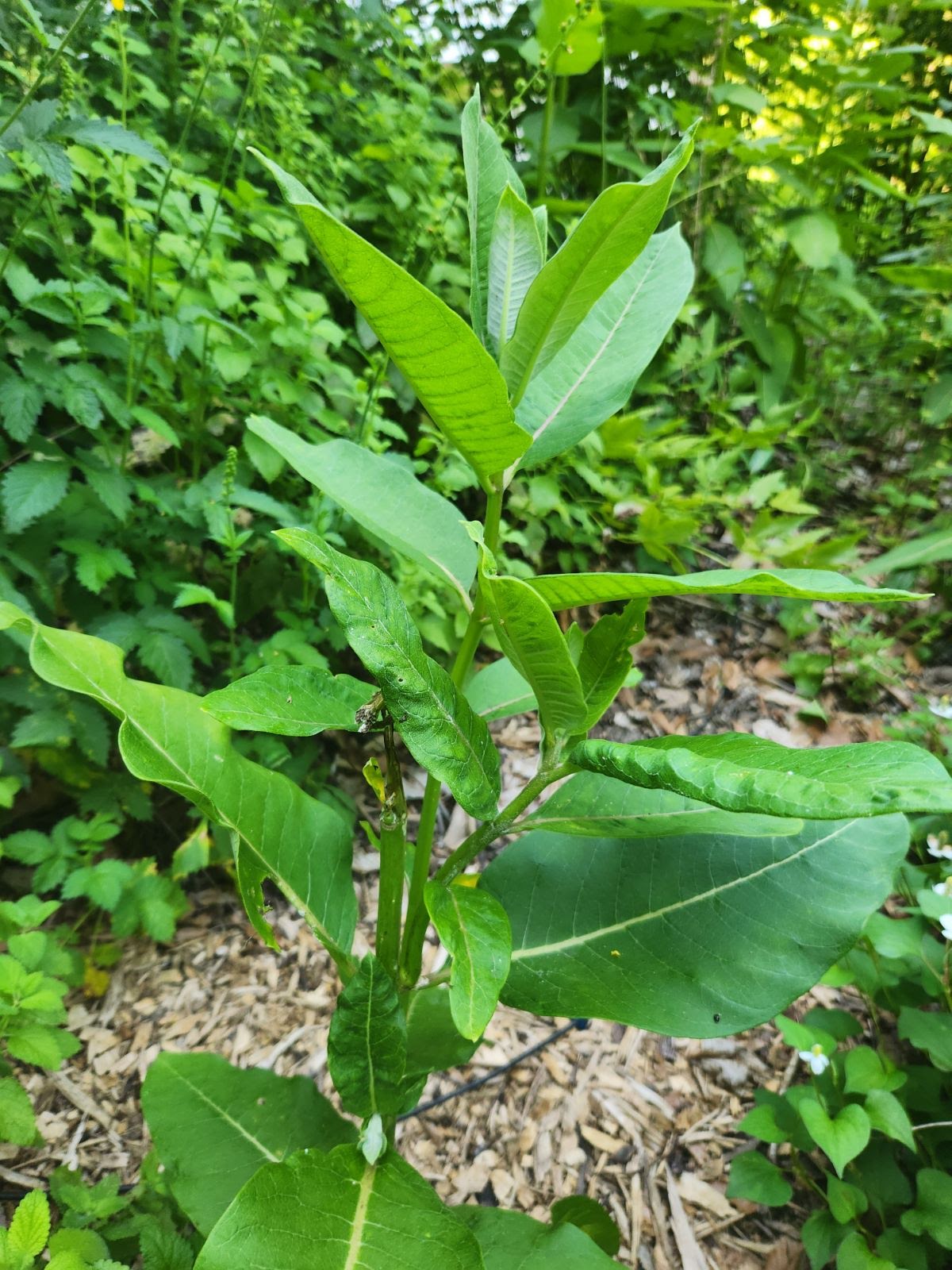
Below are two plants that were chomped earlier this season, bouncing back with vigor: Common Milkweed (Asclepias syriaca) left and Valerian (Valeriana officinalis) right. The “Chelsea chop” is a common gardening technique where gardeners cut a plant back early in its season so that it will branch out and produce more blooms at shorter heights, preventing some that might otherwise grow tall and spindly from flopping over as they bloom and set seed. The reason that works is the plants’ adaptation to respond in this way to herbivory. This Valerian wound up being one of the taller specimens in the garden anyway!
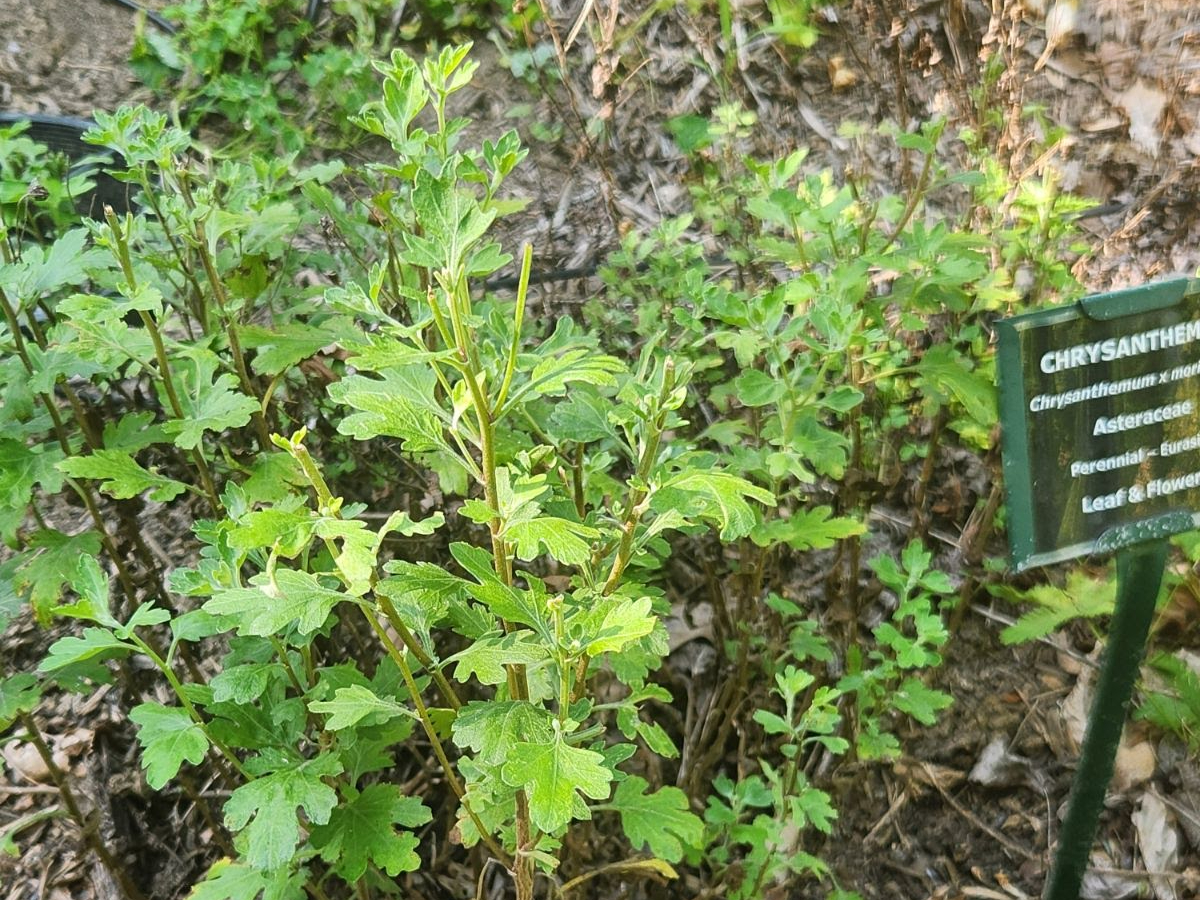
Many of the species our herbivorous neighbors have been munching aren’t ones we would normally cut back, but this Chrysanthemum x morifolium is. I love when the deer help with the gardening!
One of my favorite animal signs are these Leaf-cutter bee harvests. For some reason, they really like to use the leaves of Dioscorea villosa, and do so every year! These native bee species use the circles they cut (bite) from leaves to build cells to hold eggs in their nests.
Bumblebees love the Common Milkweed (Asclepias syriaca) that’s rapidly proliferated in the native section of Terrace A after germinating there a couple seasons ago. This month I learned that Milkweeds are high-stakes nectar sources for many pollinators, because their pollination strategy requires the insect to pull their leg out of a sticky slit where they pick up the flower’s pollinia. Bumblebees are larger than many other pollinators, and we’ve never seen a dead one in the Milkweed, but folks in the region have been seeing dead honeybees who didn’t manage to escape their Milkweed traps!
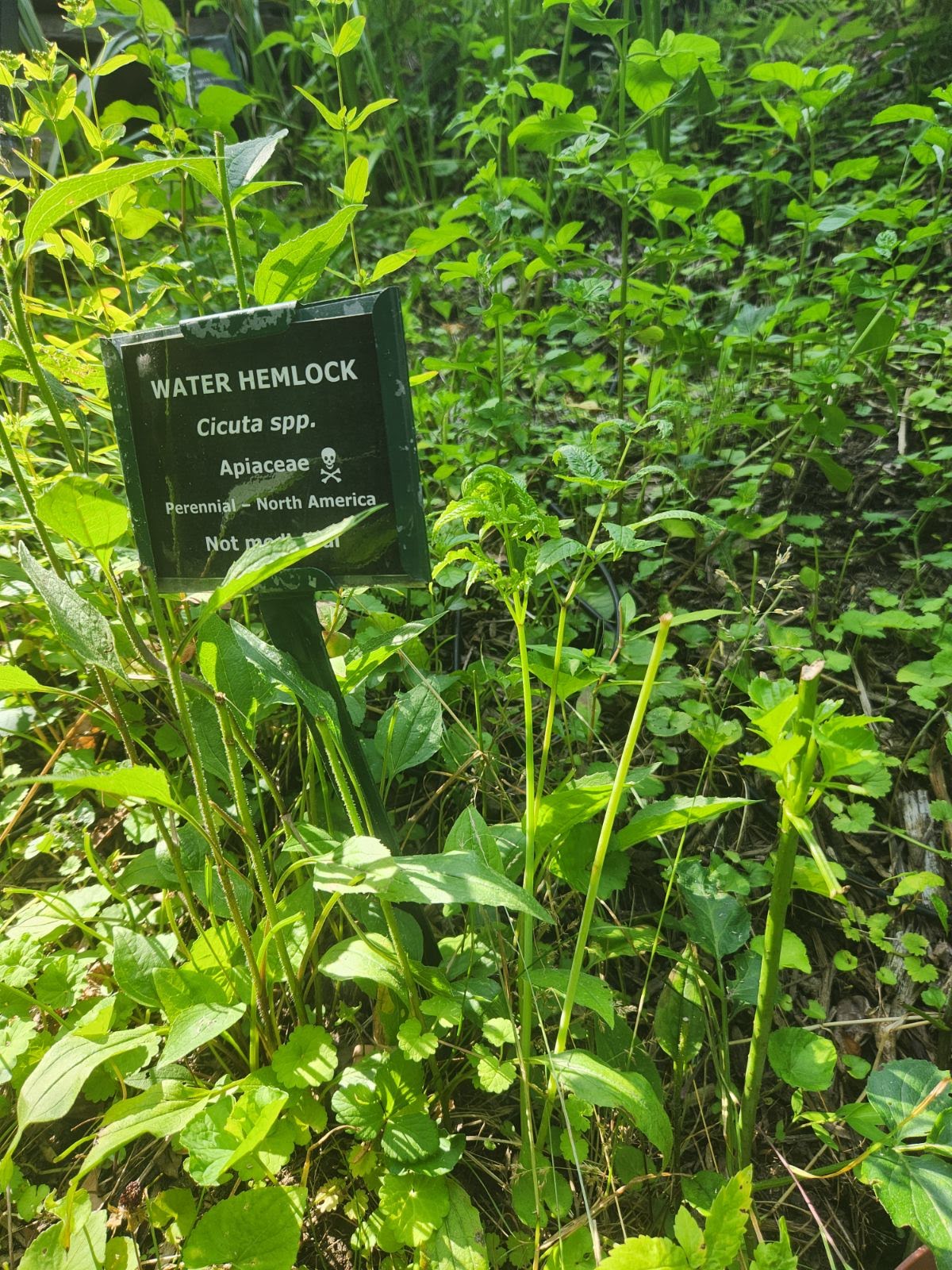
Deer (and Groundhog, and bunnies) continue to appreciate the Garden’s abundance and diversity. Instead of dumping all the photos, today I’ll just offer these 2 outstanding examples: the deer are hammering the Sochan (Rudbeckia laciniata) in the Garden this season, but fortunately this resilient, edible, and medicinal native plant has self-seeded all over the grounds, and the plants by the pond, the magnolia, and around the house are being left largely unmolested. Water Hemlock (Cicuta maculata) is widely considered the deadliest plant in our region (surpassing even the better-known Poison Hemlock, Conium maculatum), with only a small amount capable of killing even large mammals like humans: “cicutoxin.. can cause delirium, nausea, convulsions, abdominal pain, seizures, and vomiting within 60 minutes of ingestion – frequently leading to death.” Hopefully it was a large deer who sampled 2 fronds of this specimen along with the Echinacea (Echinacea spp.) and Elder (Sambucus spp.).. and maybe they spat it out without ingesting a deadly dose of cicutoxin??
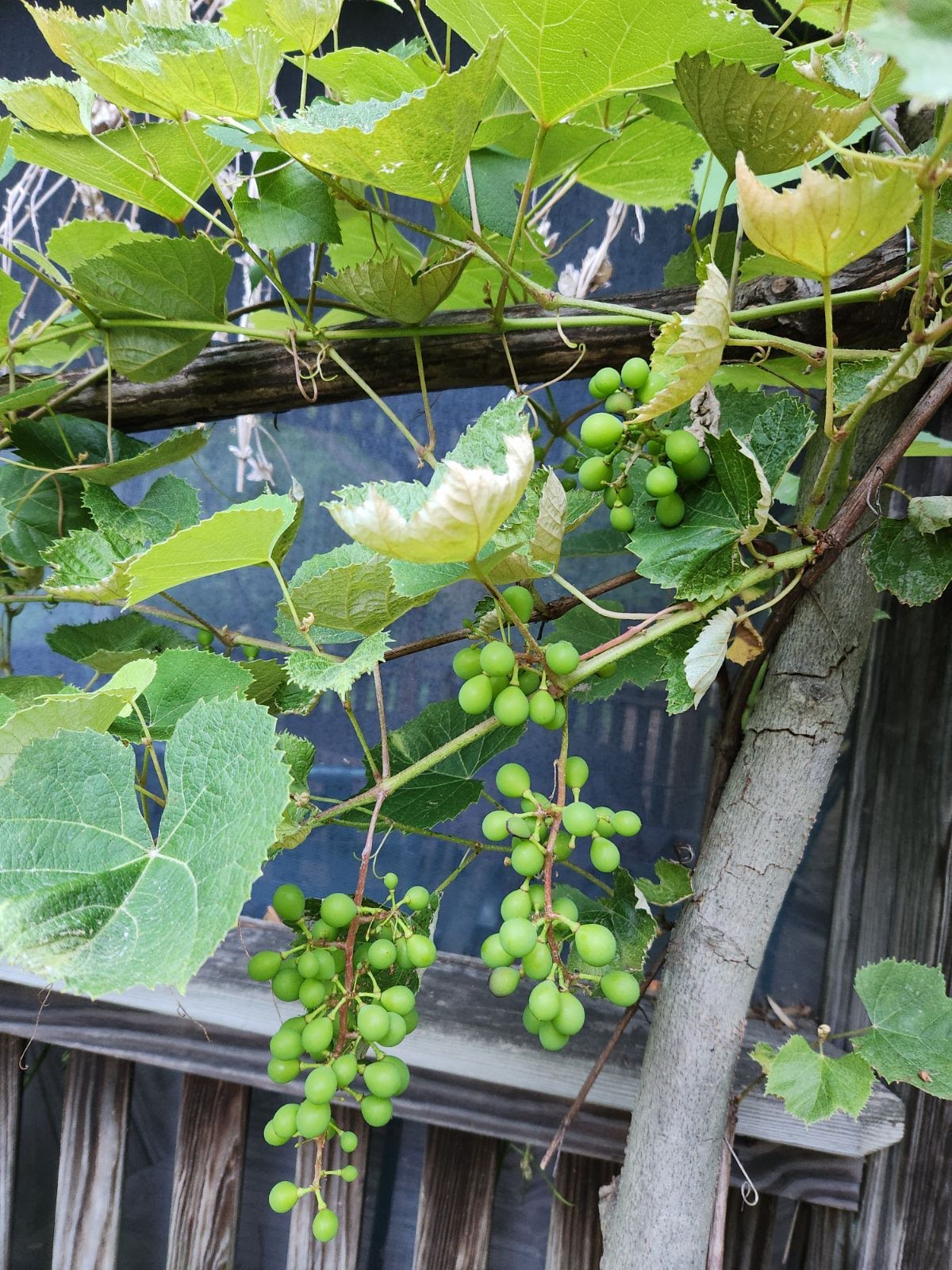
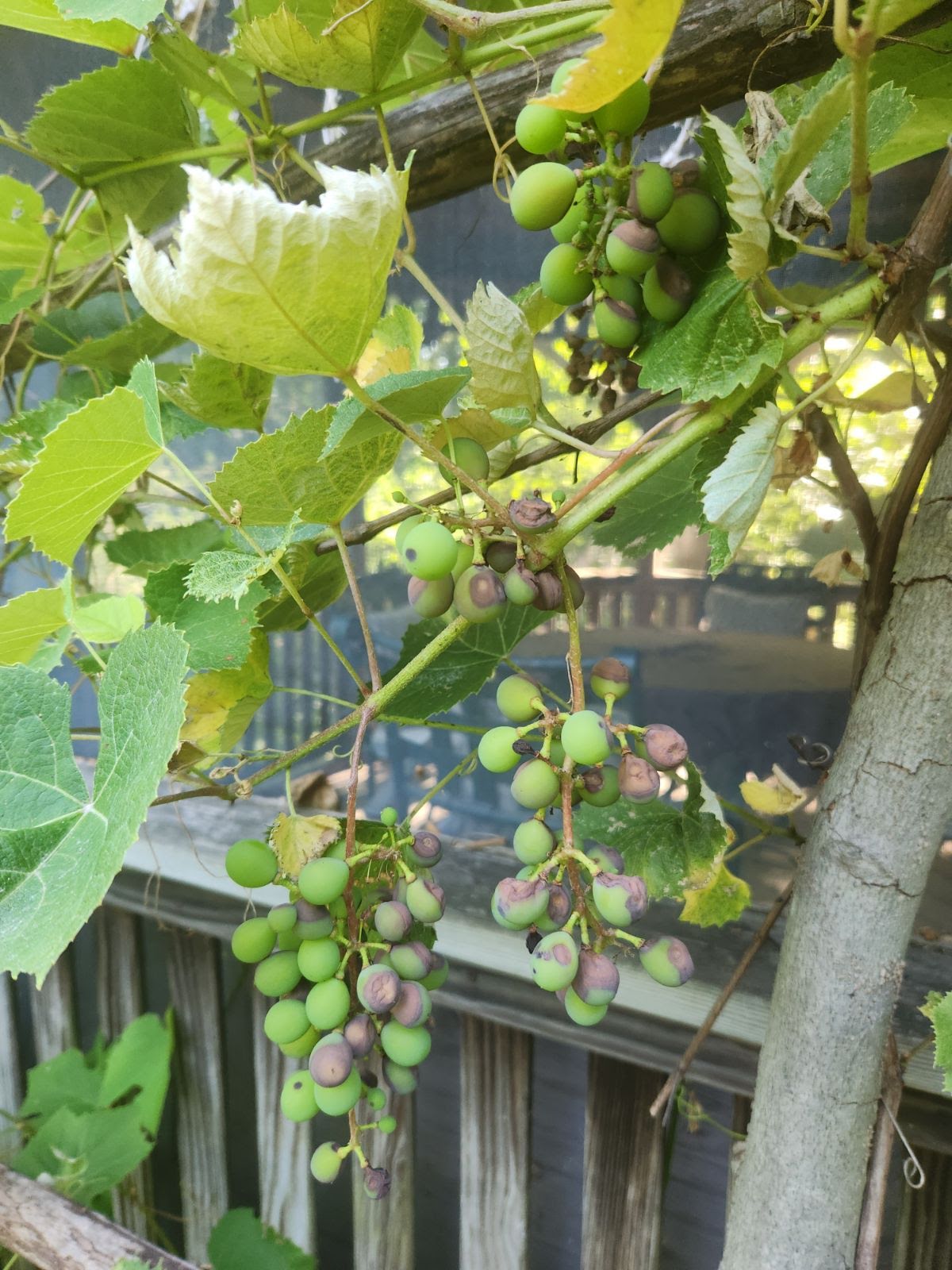
Despite looking great on June 12, Black Rot (Guignardia bidwellii) devastated a lot of fruits in these grape clusters by June 19, and more beyond:
As always, please explore our public event offerings to experience all this intrigue in person, this month including a Tuesday evening Climate Café and more! -Veri
All photos the creative works of Veri Tas, except Io moth, kids-in-walnut, and creepy-crawlies by Julie Biedrzycki
We’re squeezing a lot into this Spring finale.. grateful for all the rain this season, and also for the breaks in between.
This spring has seen a curious and concerning wilting phenomenon throughout the garden, affecting various but specific woody plants from different plant families. The Yellowroot (Xanthorhiza simplicissima, Ranunculaceae family — below top right and bottom left)) leaves started displaying this symptom a year or two ago, but it hadn’t affected any other plants. The big Ginkgo (Ginkgo biloba, Ginkgoaceae family) was most noticeable this year, with the loudest, largest statement, but all 6 Ginkgos in the garden are displaying it (below, bottom right, are curled ginkgo leaves in the Aphrodisia plot). We also noticed that the big Cucumber magnolia (Magnolia acuminata, Magnoliaceae family — below, top right) below the pond is affected, along with several other large trees. If you know what’s causing this symptom or who to ask, please let us know!
Continuing my inventory of who the deer are chomping, I’ve snapped a lot of pix of their choices throughout the garden. It’s common knowledge that wildlife tend to preferentially consume species that they’ve established cross-generational food relationships with, and that’s a large reason exotic plants often proliferate in novel ecosystems — the local fauna aren’t accustomed to consuming them and may not be well-adapted to overcoming the self-defense mechanisms they employ. Unchecked deer populations tend to apply heavy herbivory pressure to native woodland species in our area, but many gardeners also note them eating garden vegetables and landscaping plant choices.
Some of their native snack choices are pictured above, clockwise from top right: * Solomon’s Seal, Polygonatum biflorum, in the Holding Plot — this is really the only upsetting damage this season. Most of the deer nibbles are on widespread, prolific, or “weedy” species, but Solomon’s Seal is a standout native woodland edible and medicinal plant that’s under-represented on the property overall and which we’d love to be able to harvest and use and share for food and medicine. It’s also gorgeous. Nearly every stem in the Holding Plot was chomped, and we don’t know if the roots’ll have it in them to send up another flush. * Sweet Cicely, Osmorrhiza longistylis – every leaf munched from this specimen that self-sows around the shady parts of the garden * Ground cherry, Physalis spp. – I’ve never seen these chomped before, but in this plot every seedling was beheaded * Goldenrod, Solidago spp. – various Goldenrod species throughout the garden have had their growing tips nommed * Honewort, Cryptotaenia canadensis – a native woodland plant not indicated in any garden plots but welcomed in the Heart Disease plot as an edible native and host plant of the Black Swallowtail butterfly. As pictured below, most plants indicated for this plot have been shaded out over time by the giant Ginkgo that’s become a standout feature of the Garden, with mainly Sweet Woodruff (Galium odoratum) proliferating lushly and the Peony (Paeonia lactiflora), Motherwort (Leonurus cardiaca), Blessed Thistle (Cnicus Benedictus), Dan Shen (Salvia miltiorrhiza) long gone. The treasured Sweetgrass was floundering here as well, but as you’ll see a bit further down, has responded vigorously to a change of place. * Fleabane, Erigeron spp. – though not planted in the Garden on purpose, many native species in this genus have both medicinal applications and wildlife benefits.
More native plants the deer have sampled pictured below, clockwise from top: * Wild Yam, Dioscorea villosa – though it’s on United Plant Savers’ At-Risk native plant list, this species proliferates in the Garden and grounds here. This arching specimen in the Holding Plot has had every leaf munched from the 2 nodes pictured, though the leaf stems (petioles) still show the rare whorled (more than 2 leaves emerging from a single stem node) leaf arrangement of this species. * Sochan, Rudbeckia laciniata – this plant is a traditional food of the Cherokee and other Turtle Island Indigenous peoples, the right to harvest which on their ancestral lands, as maintenance of their traditional life-ways, has only recently been restored to them in Great Smoky Mountains National Park. * Carolina Rose, Rosa carolina – those thorns deter me from even touching these stems, but the deer may have caught them at a soft enough stage (like I do sometimes with Tear Thumb/ Mile-a-Minute, Persicaria perfoliate, leaves that have a line of prickles running down their medial vein!)
My favorite native deer choice to watch and study is the Mayapple (Podophyllum peltatum), whose toxicity is well-known, and which many gardening resources will claim deer “don’t eat.” For the past few years, the deer have pretty reliably been munching the young Mayapple leaves around the Goldenseal patch in the Leukemia plot, which delights me so much as free, collaborative Garden maintenance! As you can see in the top photo below, the Goldenseal leaves (bottom) and Mayapple leaves (top left) & plants share a LOT of characteristics, from height to plant structure — 2 palmate leaves of similar size forking from a stem about 1′ off the ground. The deer “weeding” the Mayapples out of the Goldenseal patch helps us in our educational mission to teach people about these and other plants and their uses.
Below bottom right and left are just more photos of just how much deer “don’t eat” Mayapple ;). I think it may still be valid to claim that the plant is “deer resistant,” though, because they really do only sample it, relative to the size of the patches. This plant is colony-forming, and spreads via underground rhizomes, which are not eaten in the deer’s browsing, and can send up more shoots later.
Though they inarguably do prefer natives, the deer sample plenty of exotic species as well, including as pictured below, clockwise from left: * Damask Rose (Rosa damascena) – it’s this plant’s second season in the garden and we’re thrilled it survived the move and the winter.. hopefully the deer browse doesn’t set it back too far either. * False Hawksbeard (Youngia japonica) – though not grown in the Garden intentionally, this plant is both edible and used in Traditional Chinese Medicine * Hawthorn (Cretaegus laevigata) – this poor tree has been hit SO HARD by rust (Gymnosporangium sp. fungus) in the past several years that we thought we’d have to take it down, but it may have decided to fight for its life. It seems to have skipped blooming this year and looks minimally affected by the fungus this season, so perhaps it diverted that energy into chemical defenses?
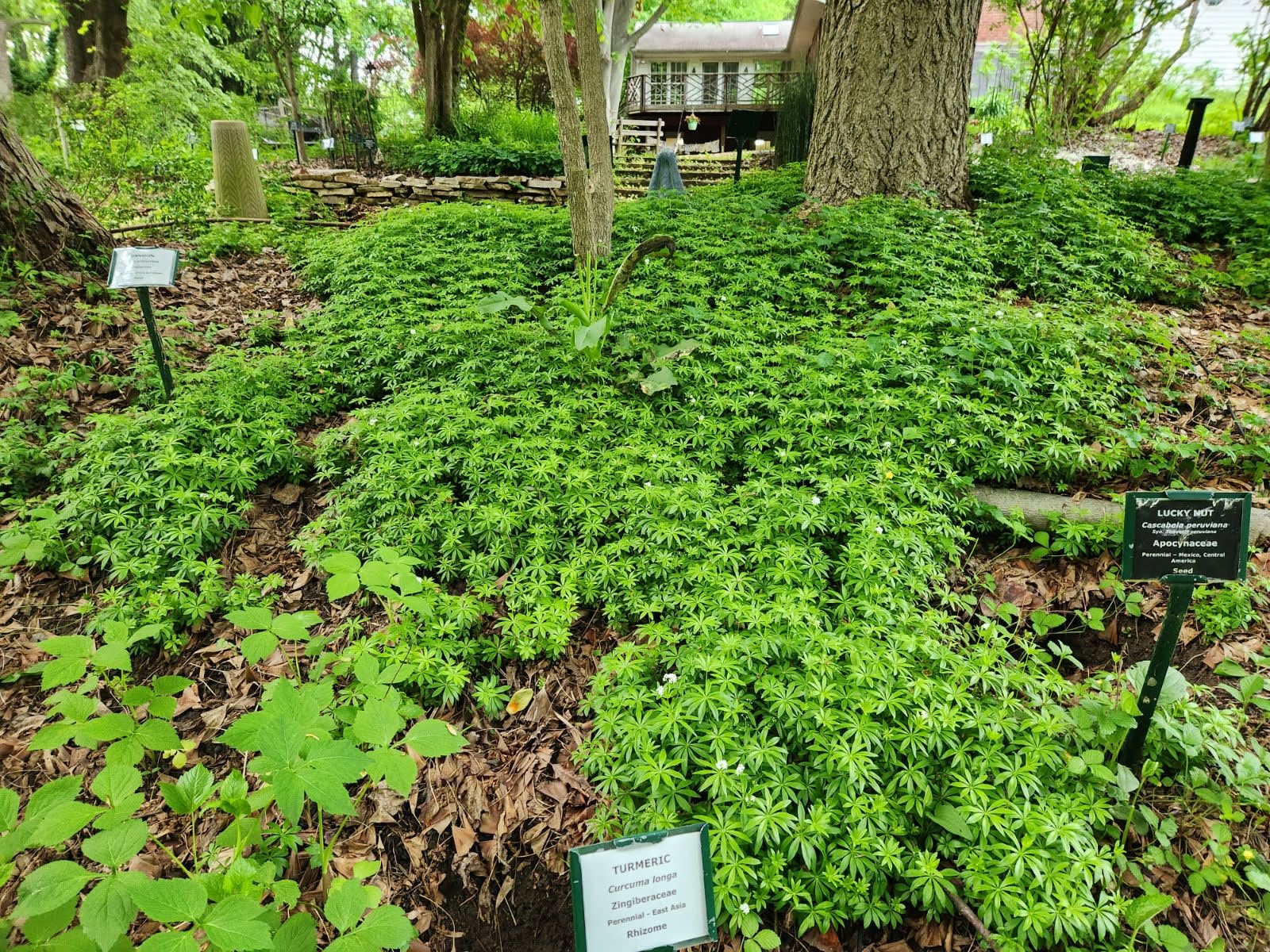
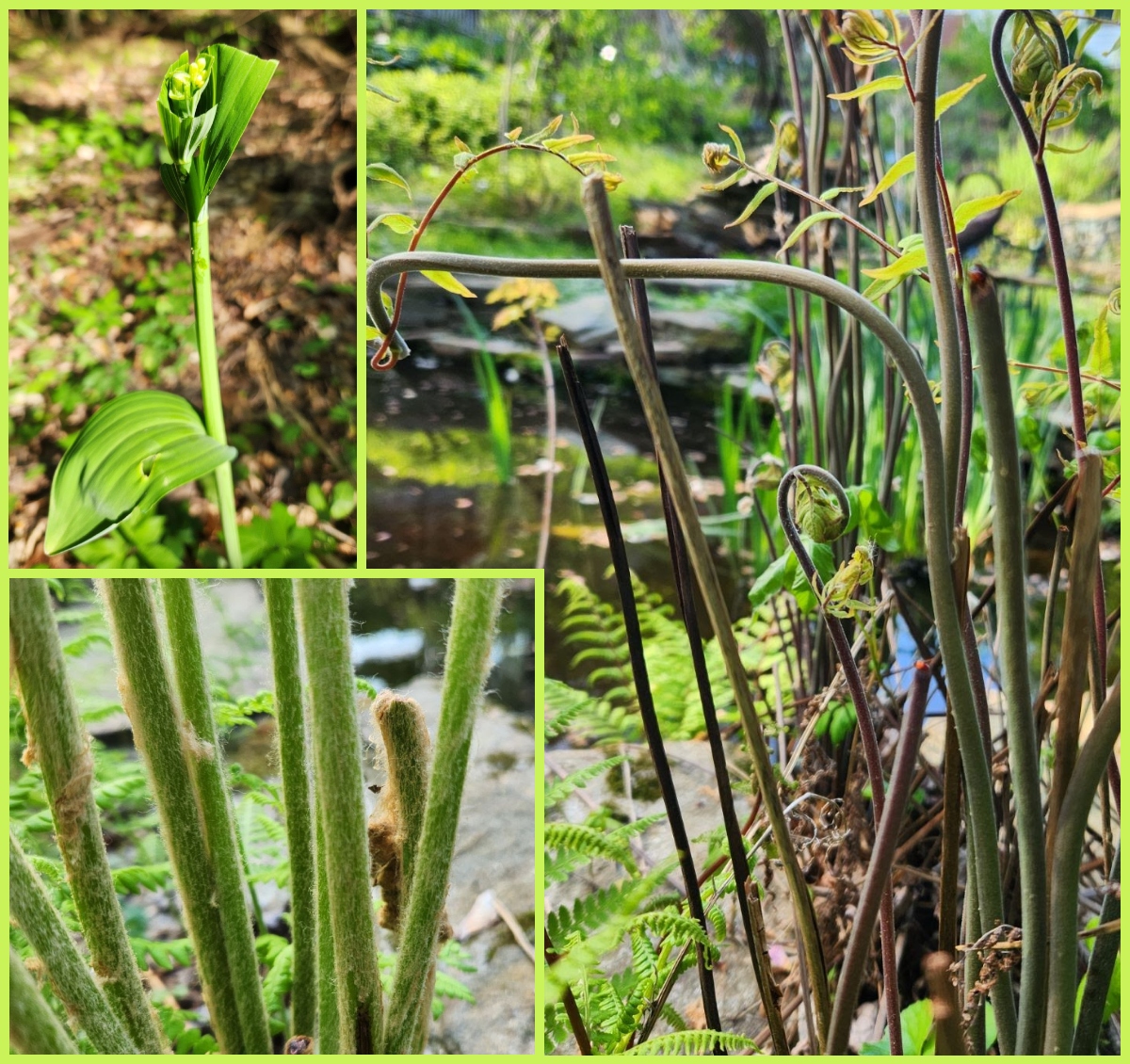
And of course, there’s plenty going on in the garden that’s not got to do with fungal infection and deer.. here’s a selection of Spring treats, below clockwise from top left: * Black Walnut (Juglans nigra) seedling emerging from Black Walnut * (bird?) egg – anyone know whose? * False Unicorn Root (Chamaelirium luteum) blooming – this native species is on United Plant Savers’ At-Risk plant list, with “Critical” status. We hope to learn how to propagate and share it, because it’s not made any babies here on its own. * native Cinnamon Fern (Osmunda cinnamomea) and Royal Fern (Osmunda regalia) by the pond showing off their colorful fertile fronds * Milk Thistle (Silybum mariana) blooming in Terrace A, always a show-stopper
And finally! I’m pretty sure this is the youngest Poison Ivy (Toxicodendron radicals) plant I’ve met, popping up in Terrace A under a Viburnum (below, top left).
Common Milkweed (Asclepias Syriac) buds (below, top right) are one of my favorite wild forages – in our Foraging Walk tomorrow we’ll discuss ethical and sharing considerations for folks aware this plant is important for Monarch butterflies. At bottom right below is the first Monarch (Danaus plexippus) egg I’ve spotted this season. Humans and monarchs (and aphids and Milkweed bugs and more) can all share in the bounty and blessings of this plant — and have done so in this region for millennia!
As promised, below at bottom right is the Sweetgrass (Hierochloë odorata) colony now flourishing in Terrace B. As Robin Wall Kimmerer explains in Braiding Sweetgrass:
“Grasses are beautifully adapted to disturbance—it’s why we plant lawns. When we mow them they multiply. Grasses carry their growing points just beneath the soil surface so that when their leaves are lost to a mower, a grazing animal, or a fire, they quickly recover… harvesting thin[s] the population, allowing the remaining shoots to respond to the extra space and light by reproducing quickly.
With a long, long history of cultural use, sweetgrass has apparently become dependent on humans to create the “disturbance” that stimu- lates its compensatory growth. Humans participate in a symbiosis in which sweetgrass provides its fragrant blades to the people and people, by harvesting, create the conditions for sweetgrass to flourish.”
To honor the plant and its relationships with and interdependence with Indigenous cultures, we want to offer divisions of this Sweetgrass to community members from those cultures. If you are or know such a person and want to grow Sweetgrass, we’d love to care for our patch by sharing it with you; please reach out!
We’re super excited to offer our first child-centric public event next weekend, Children’s Day Extravaganza! Coming out for this month’s Herbal Medicine-Making class (currently 3 tickets available) will score you several infusing culinary preparations to take home. We’ve also expanded our Scholarship program and implemented an “early” registration policy, in hopes of making our offerings accessible to more people. Please check it all out, and feel free to reach out with any questions, concerns, proposals, or offers to support our work!
Happy Naked Gardening Day! And May Day, and Beltane! So many opportunities to celebrate the height of Spring 🙂
In the Garden Terraces, Crampbark (Viburnum opulus), Hardy Orange (Citrus trifoliata), and Bloodroot (Sanguinaria canadensis) have finished blooming. Leaves of biennials that overwintered as little basal rosettes, like Milk Thistle (Silybum marianum) and Mullein (Verbascum spp,) have grown by a factor of more than 10x. Solomon’s Seal (Polygonatum spp.), Lily of the Valley (Convallaria majalis), and Sweet Woodruff (Galium odoratum) are in full bloom, and the biggest perennial shoots (eg, Carrion Flower – Smilax herbacea, top left below) are now erupting. Meanwhile, Hops (Humulus lupulus) bines* are pushing 6′ tall (top right below), many Alliums are blooming and already approaching their dormant phase, and the Roses are starting to come on.
Also pictured below (bottom, left to right): Bee Balm (Monarda didyma) in our area is often infected with Powdery Mildew shortly after its bloom time, which makes harvesting its foliage undesirable for food or medicinal uses. A member of the mint family, this native grassland and edge species spreads laterally by underground rhizomes and branches at each above-ground node, so it can bounce back from numerous harvests. Though the red pom-pom flowers it will soon produce are a delight to work with, the leaves themselves are very flavorful and delicious as well, and now’s the best time to harvest them to beat the mildew. Our Fairy Wand (Chamaelirium luteum) buds are preparing to erupt. This herbaceous native is dioecious, meaning individual plants tend to bear only either male or female reproductive organs, not both like many plants folks’re familiar with like Tomato and Tulip. This native plant has historical medicinal applications for the female reproductive system but can be challenging to propagate. In the Garden it’s a specimen for honoring and appreciating, but not harvesting. To our surprise & delight, a small flush of Oyster mushrooms (Pleurotus ostreatus) has already emerged from a log inoculated at a Workshop last fall now living (well, the fungus is living — the log of course has died) in Terrace B
* That’s right, the twining stems of the Hops plant are called bines, not vines, which climb using tendrils, suckers, or other appendages. Hops bines have only stiff hairs and the twining action to accomplish their ascent.
Even though specimens or populations in certain locations have been threatened or harmed by deer browsing or competition from other species, we’ve been delighted this season to spot a lot of native plants in the woods that are either new or had escaped our notice in previous years. My photo attempts didn’t turn out great, but I’ve been especially gratified to notice many Greenbriers (Smilax rotundifolia), whose absence I’d lamented for several seasons, as I love nibbling their nascent leaves and stems as they grow. I do suspect they’ve been there all along, but it took me awhile to become attuned and familiar enough to notice them.
Pictured below, clockwise from top right: * Wild Yam (Dioscorea villosa) bears stunningly elegant leaves in a whorled pattern around the stem * Wake Robin (Trillium erectum) – Tbh this one’s a recent rescue from another garden, but none the less worthy of celebration for it! * Black Cohosh (Actaea racemosa) proliferates in the Menopause and Tinnitus Garden plots where it’s grown intentionally, but hasn’t historically been well-represented in the woods onsite. This year we noticed this one nestled under some monstrous Ostrich Ferns (Matteuccia struthiopteris) right alongside a path. * Jack-in-the-Pulpit (Arisaema triphyllum) As a long-lived perennial of over 20 years, I expect to see these plants make their appearance year after year, but some of the several champion specimens from previous years may have passed on. This one I hadn’t noted prior is a stunner, to be sure! * Foamflower (Tiarella cordifolia) We’ve planted and tended a few of these over the years, but none of us remembers this one that grabbed my eye this season! Exciting to think maybe it chose to live there on its own. * Solomon’s Plume (Maianthemum racemosa) Most explanations you’ll find point out the difference in the inflorescences of this plant and Solomon’s Seal (Polygonatum biflorum) as the key to distinguishing them, but of course they only bear flowers (and then fruit) at certain stages of their lifecycle. I find the signature zigzag — graceful and delicate yet uncompromising — of Mainthemum’s stem more than sufficient to discern it from Polygonatum, which works any time beyond their emergent shoots!
I always watch with interest which plants the deer & other herbivores are chomping. Hostas are a well-known deer favorite among gardeners, but at the GFG this year they were hardly touched. Funnily enough, we saw numerous different fern species that Had been munched, despite ferns typically being considered deer resistant plants on the whole.
Pictured below: two ferns around the pond showing browsing damage, and, top left, one of the only Solomon’s Seal (Polygonatum biflorum) shoots we’ve seen in the woods, nibbled straight through to the flower buds nestled within the emerging leaves.
Unfortunately our May Foraging Walk had to be cancelled for both personal and weather reasons this weekend, but in addition to Monarda, Milkweed shoots are a wild food we’d recommend trying this month – especially if you’ve got a patch you already steward for the Monarchs!
Densely erupting Milkweed shoots like those pictured above can be thinned to give individual stalks more space, without harming the spreading underground rhizome network. Depending on the specific conditions surrounding them, stalks packed in this tightly may even fall over as they grow to full height, as they spread out diagonally trying to get their own space. As all gardeners learn, plants spaced too closely are also more susceptible to fungal infections, as crowded foliage inhibits air circulation and thereby water evaporation.
Having evolved to survive life on Earth, plants employ a wide variety of strategies to withstand and recover from all sorts of injuries including browsing, rubbing, lightning strikes, tree-falls, disease, and more. As Indigenous scientist and author Robin Wall-Kimmerer explains in her book Braiding Sweetgrass (published by Milkweed Editions!), harvest by humans can be done in ways that support the long-term health and well-being of the populations of other species with which we relate. In her words, perennial plants (she’s referring to Allium tricoccum, in the chapter “The Honorable Harvest” quoted here) can “tend to become crowded in the center of a patch, so I try to harvest there. In this way my taking can help the growth of the remaining plants by thinning them out. From camas bulbs to sweetgrass, blueberries to basket willow, our ancestors found ways to harvest that bring long-term benefit to plants and people.”
I look forward to sharing more Foraging considerations and resources with you, visiting many forgeable plants common in our region, and preparing for the onset of BERRY SEASON, at our June 2 Foraging Walk. This month, we hope to see many of you for the Annual Tropical Plant-Out!
All non-logo images the creative works of Veri Tas
What a difference a month makes! The Hellebores (Hellebore spp) are still going strong, but many of the native spring ephemerals have already completed their brief bloom phases. Below (clockwise from top left), a bumblebee works the Hellebores; native Bluebells (Mertensia virginica) blooming; native Golden Ragwort (Packera aurea) has a longer bloom-time than many other early spring bloomers and is just getting started; and our dainty but robust Twinleaf (Jeffersonia diphylla) blooms in Terrace D.
During its decades of history, The Green Farmacy Garden has been connected to a variety of plant research projects. One ongoing study at University of Maryland College Park sources fresh Stinging Nettles (Urtica dioica) from the Garden to explore their nutritional content and compare to those of the same species grown in different conditions.
Another study at Emory University is studying the threatened species Schisandra glabra, which though native to Southeastern states has been growing happily in The Green Farmacy Garden for over a decade. Each season we track its progress alongside its famous adaptogenic cousin, Schisandra chinensis. We always see the same pattern pictured below: Schisandra chinensis leafs out and blooms far ahead of Schisandra glabra, and our S. glabra leafs out weeks later than the native ones in Alabama, but tends to open its flowers around the same time. Below top, native Schisandra glabra is still dormant, while Below bottom Schisandra chinensis has already leafed out and is swelling flower buds.
Early spring offerings have attracted a number of young people to the Garden, which delights both us and them! We’re working to craft even more events catering to young people’s needs this season, including our Community Earth Day Celebration and a Children’s Day Extravaganza in June!
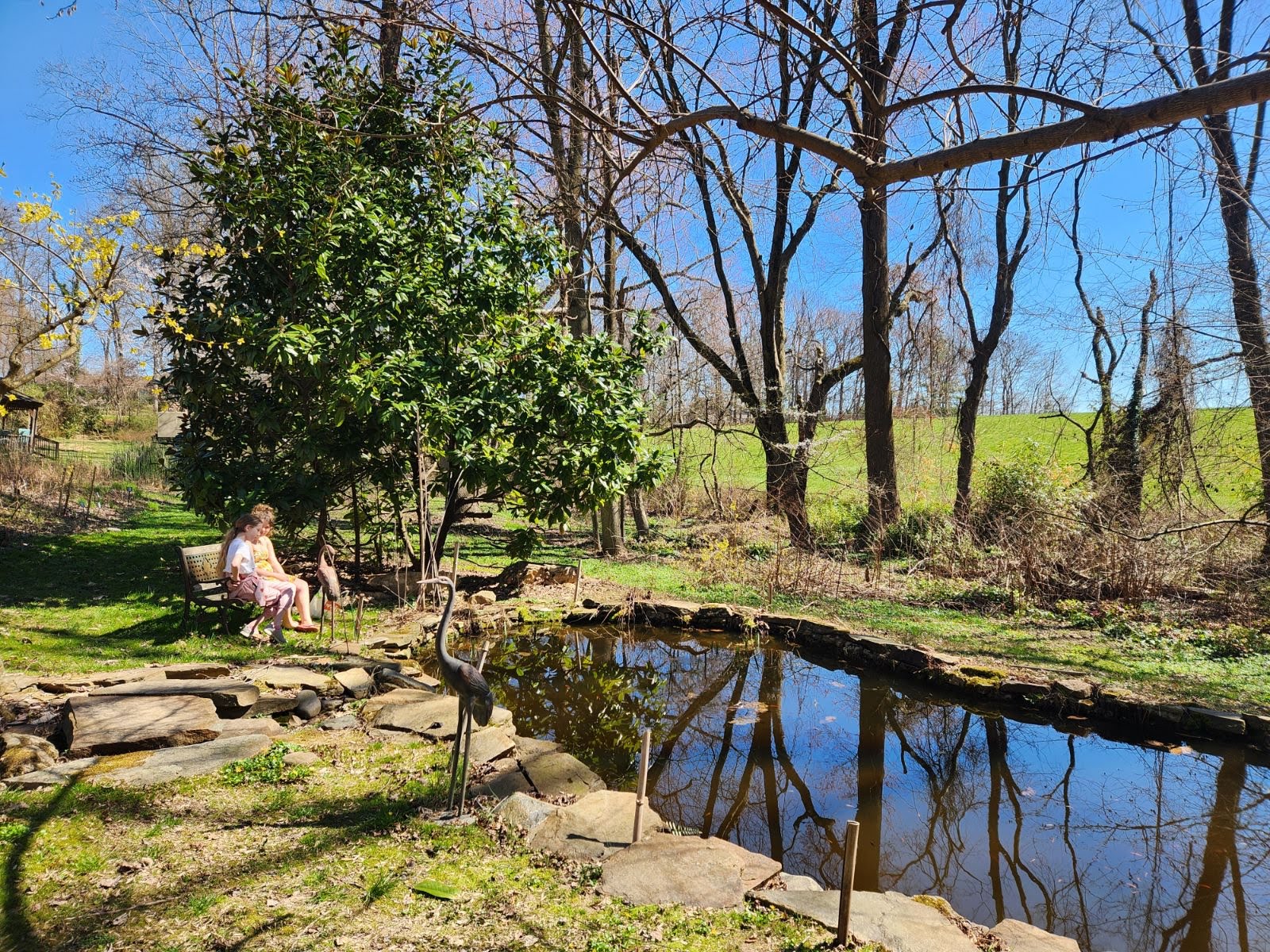
These young visitors joined us to learn about Willows at our Willow Walk & Work, supported by grant funding from Chesapeake Bay Trust and Clean Water Howard. Their attraction to the ponds underscored the value of water stewardship and connection. Water is life!
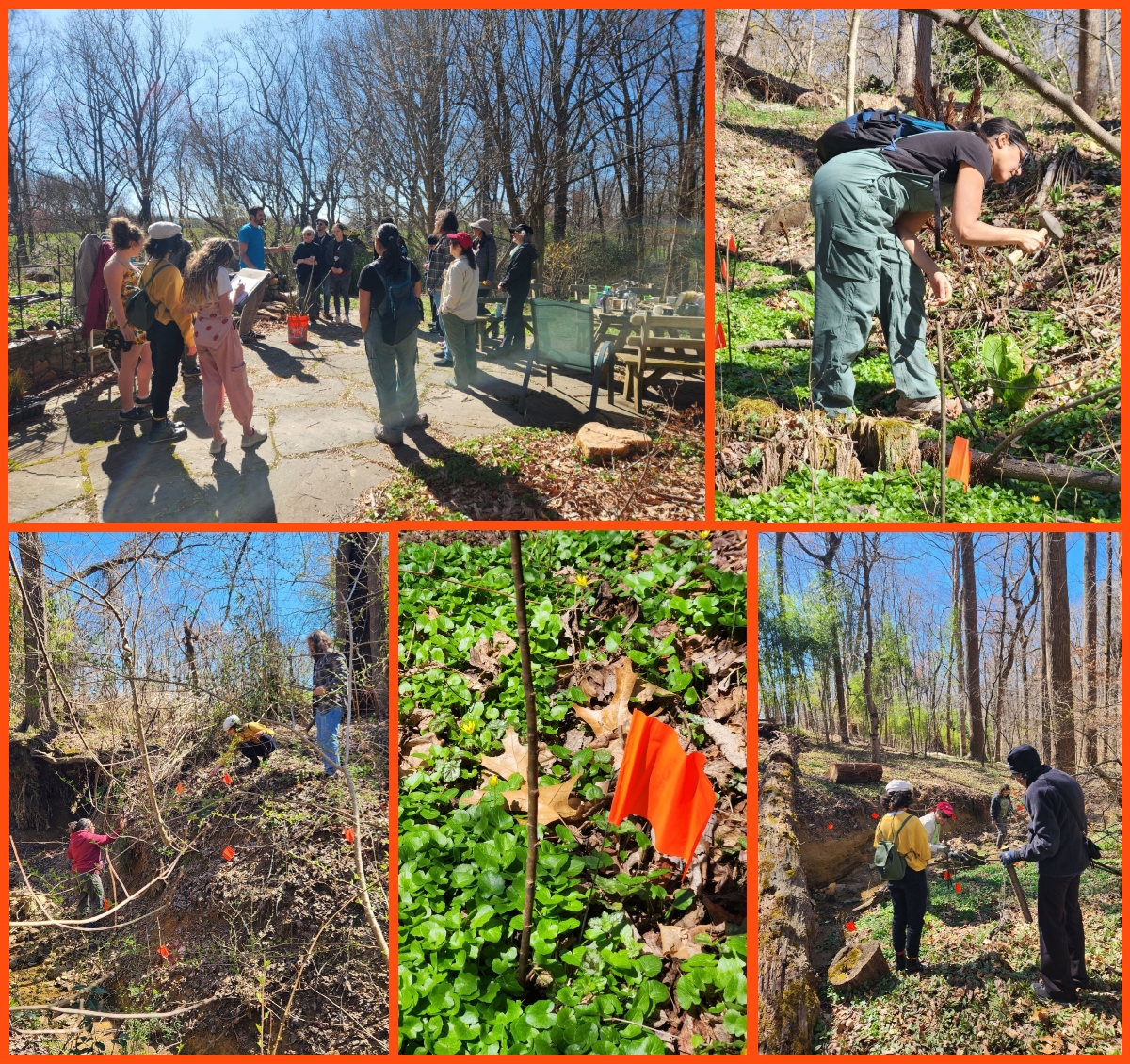
We had a strong turnout for the Willow Walk & Work. Participants learned about many ecosystem roles, medicinal applications, propagation boosts, and other functions of Willow species and then helped us install a couple hundred Live Willow Stakes along the eroded banks of one of our streams. Right now they just look like sticks in the ground (OK, they basically ARE just sticks in the ground), but hopefully many of them will do their willow magic and take root, eventually anchoring both themselves and the soil in place, to prevent further erosion.
We’re full of Spring energy and, buoyed by Grant support and support from CEI’s network, offering a bunch of events this month, which you can find on our Public Events page!
All non-logo images the creative works of Veri Tas except Bluebells, Twinleaf, and Spring Wild Edibles shots by Annie-Sophie Simard, garden group by Michael Hanes, eco-print by Julie Biedrzycki, and Tool Sharpening/ Repair Café pix by Simon Sauvageau
This morning as a group of local herb growers convened for a networking knowledge-share, we were excited by 5 hawks causing a ruckus overhead for an hour – the most we’ve seen at once! Numerous songbirds were seen and heard vacating the area. We’ll often have a hawk couple engaging in mating rituals around this time – any bird enthusiasts know if they sometimes do group displays or competitions before settling on a mate?
It’s also Fukinoto season again – read more at the link! We’d love to share the abundance, so please be in touch by email at GFG@cei.earth if you’d like to schedule a time to come harvest some Fukinoto to try at home.
Above Top: Giant Butterbur (Petasites japonicus) buds & blooms, called Fukinoto when prepared for food in Japan. Sweet Coltsfoot is another common name for this plant, though uncovering or bringing out its sweetness takes considerable preparation! Bottom: The closely related Coltsfoot (Tussilago farfara), whose buds (foreground of bottom left image) are harvested for medicine in Traditional Chinese Medicine and leaves and roots in other traditions
Below images from March 7, Clockwise from Top: abundant naturalized wild edible Chickweed (Stellaria media) lush and blooming; Forsythia (Forsythia suspense) first blooms; shy Daffodils (Narcissus spa.) hiding in the Holding Plot; first leaves breaking from the newly imported Rose from Maryland University of Integrative Health (Rosa damascena?)
Around the change of the seasons, CEI was awarded an Outreach and Restoration Grant from The Chesapeake Bay Trust, capacitating us to make some exciting progress toward ecological responsibility as we steward the terraces and grounds of The Green Farmacy Garden.
“This grant program encourages outreach, community engagement activities, and on-the-ground restoration projects that increase knowledge, change behavior, and accelerate stewardship of natural resources that involve residents in restoring local green spaces, waterways, and natural resources.“
Look for these logos on event ticket pages and the Public Events page on our website highlighting events enabled and inspired by this grant!
Already in February, this Grant has empowered us to remove exotic plants from the area around sensitive Bluebells (Mertensia virginica) and other spring ephemerals at our Woodland Walk & Work, and with the help of Howard Ecoworks, to install Log Erosion Barriers (LEB) at the top of Terrace A, to help infiltrate storm water, better hydrate the plants growing there, and decrease erosion on the steep garden slope:
Above Top: Volunteers from the public work to remove selected species from the forest floor, and Bottom: team from Howard Ecoworks helps install Log Erosion Barriers.
We’d love to celebrate the approach of Spring in the Garden with you — please find upcoming public events on our Public Events page!
All non-logo images the creative works of Veri Tas except Volunteer plant removal and stream-bed shots by Annie-Sophie Simard and Willow by Matthew Jacobsen
It’s already halfway to spring [from the solstice]!
Since we last posted, the Garden has been blanketed in & released from snow; the earliest in-ground bloomers have popped up & sprung to action; tropicals have been blooming in the greenhouse and studio; and CEI’s been awarded a Chesapeake Bay Trust Outreach & Restoration grant that will enable us to offer more opportunities to engage with and learn about the property grounds beyond the garden, as we work to improve stormwater management on the site.
Above, clockwise from top left: frozen pond; critter footprints (do you know whose?) in the woods; the barn; the patio in the wondrous white.
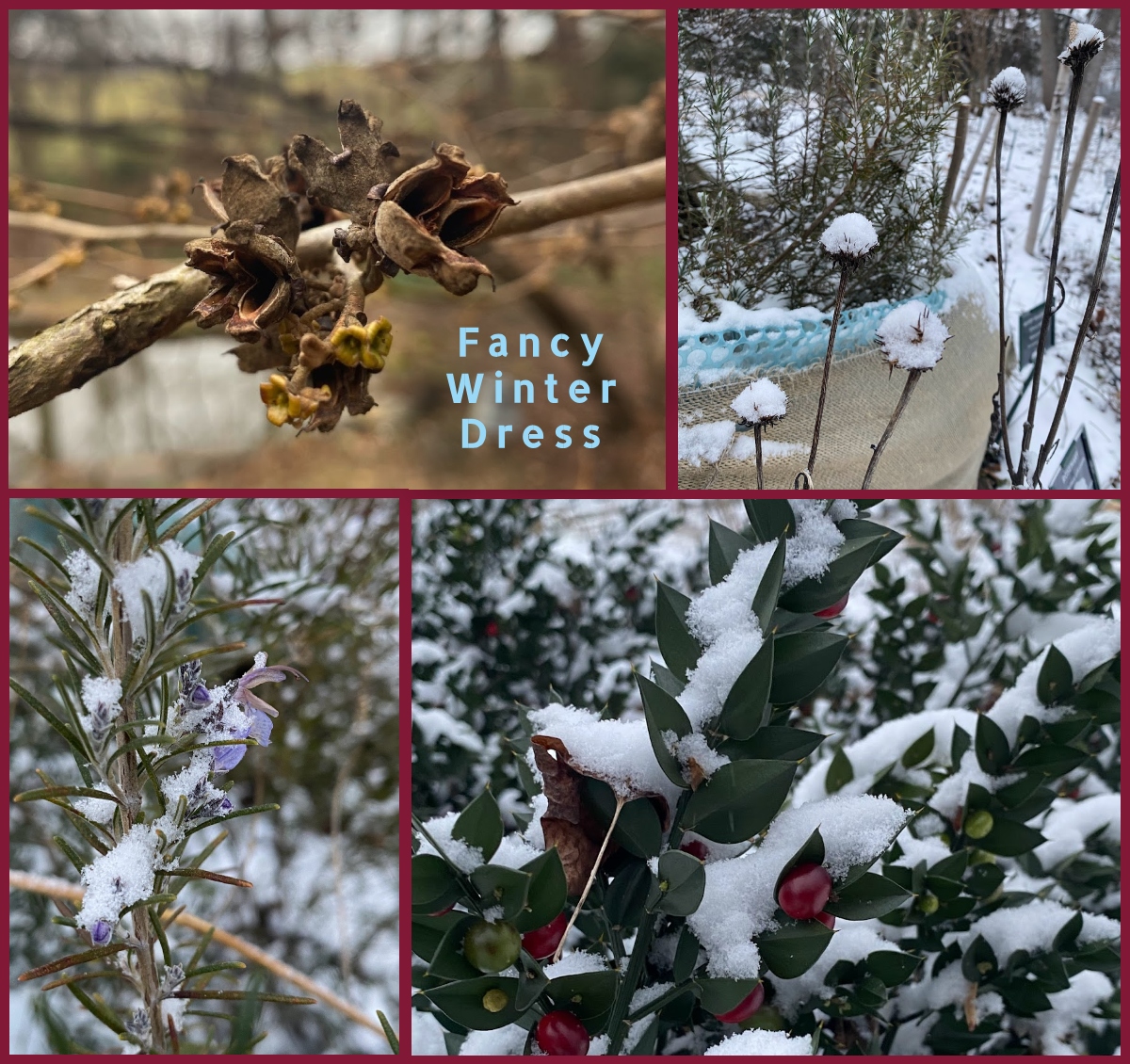
Below, clockwise from top left, some garden knockouts in winter finery: Witch Hazel (Hamamelis virginiana) requires no dressing up!; Echinacea (Echinacea spp.) seedheads bedecked with snow; hardy yet dainty Rosemary (Salvia rosmarinus) in bloom; breathtaking Butcher’s Broom (Ruscus aculeatus).
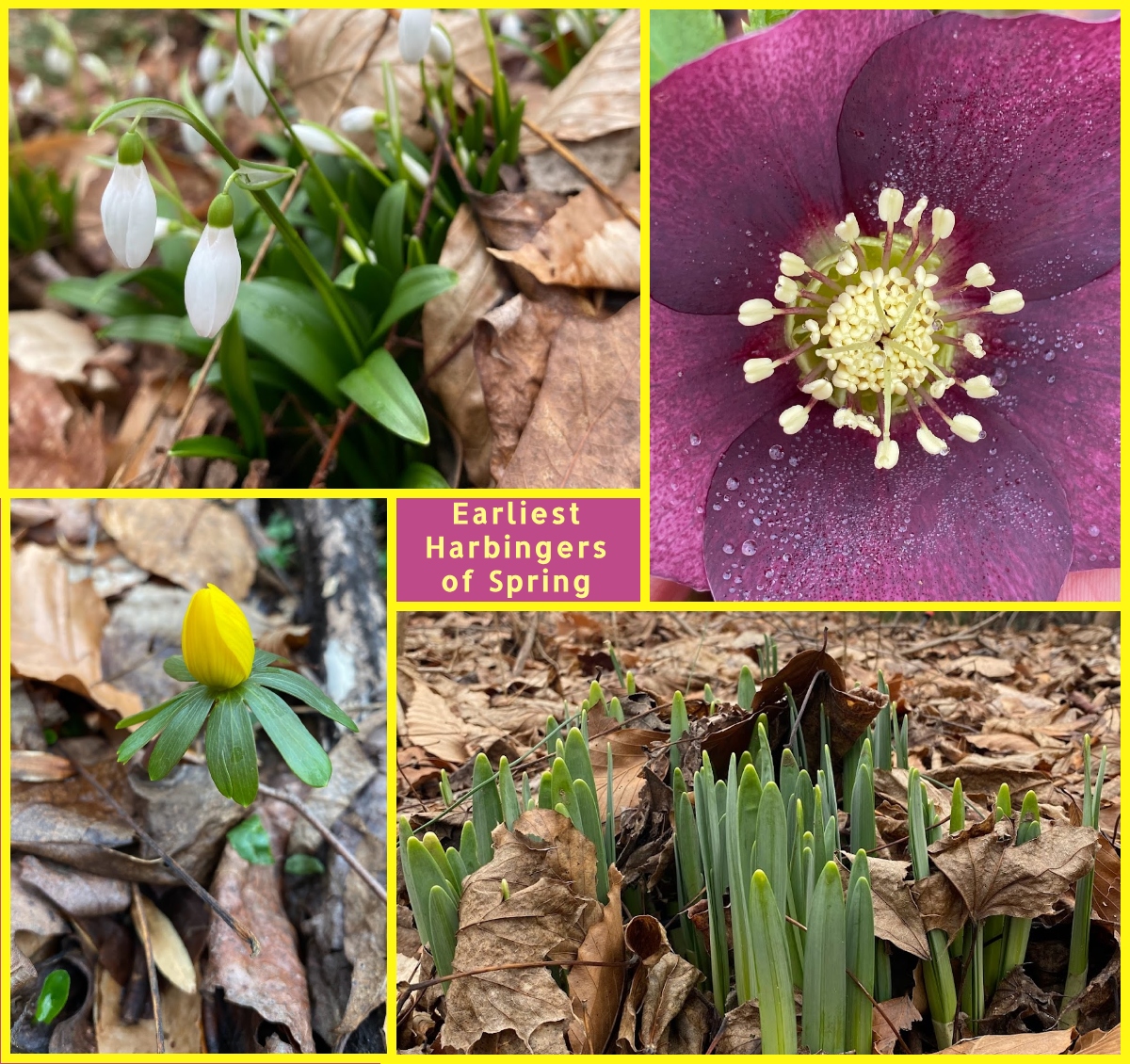
Below, spring’s earliest harbingers (all introduced species) besides the Giant Butterbur (Petasites japonicus) that’s almost certainly at least budding too, clockwise from top: Snowdrop (Galanthus nivalis); Hellebore (Helleborus spp.); Daffodil (Narcissus spp.); and Winter Aconite (Eranthus hyemalis)
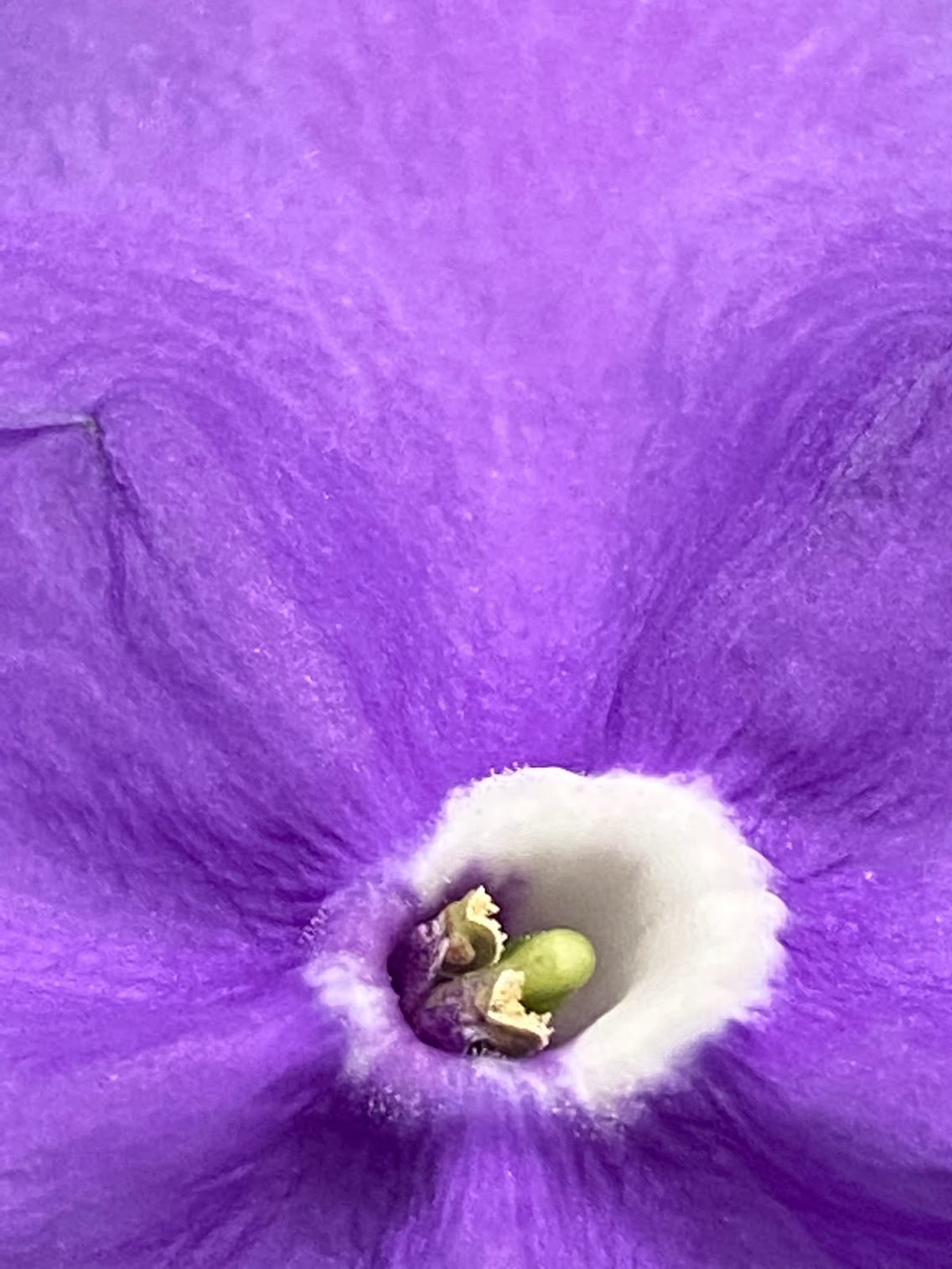
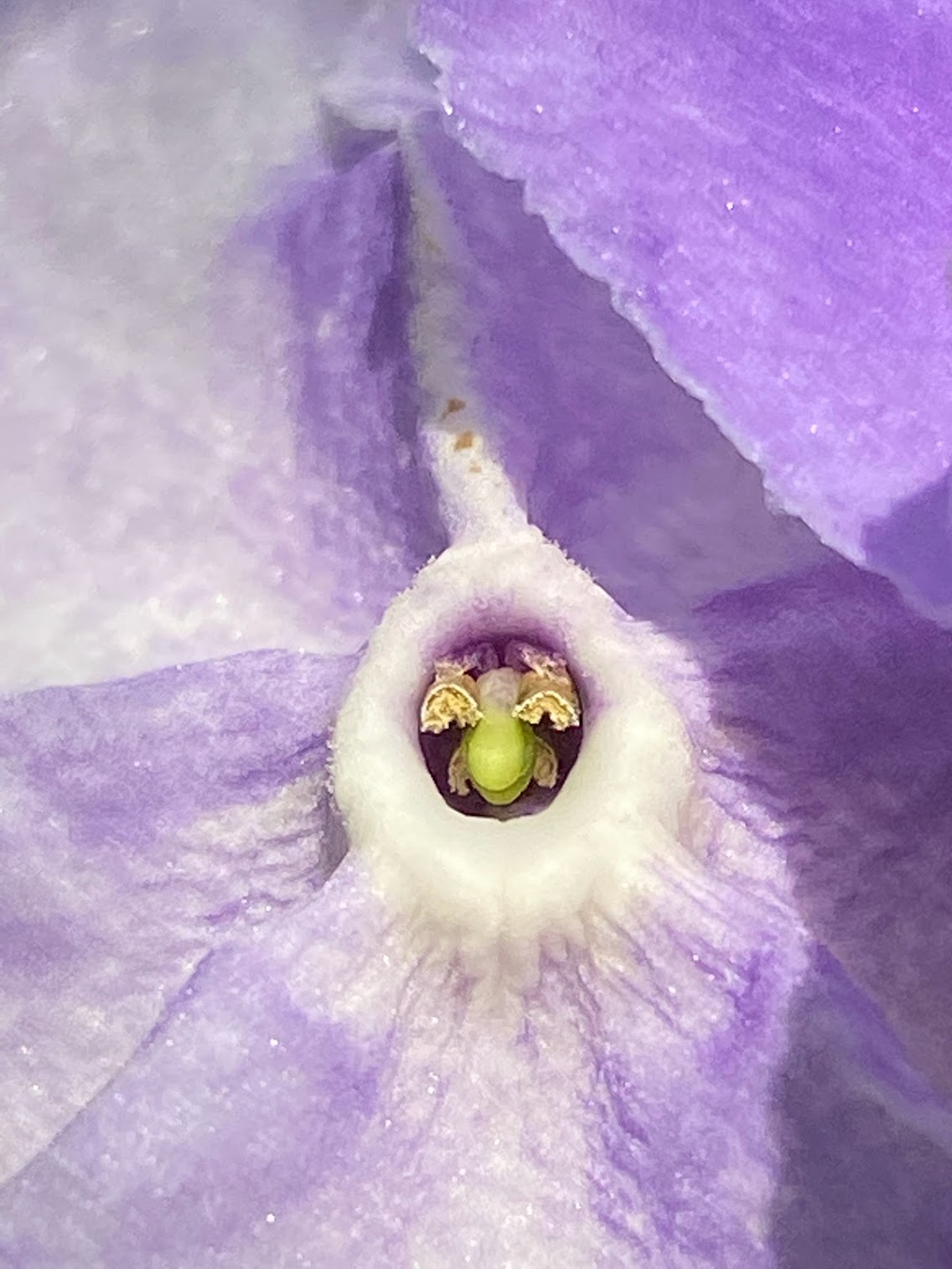
In recent weeks, the greenhouse is filled with colorful blooms, and fragrance from the oh-so-wistfully-named Yesterday, Today, and Tomorrow (Brunfelsia australis):
In the studio, the lemon tree’s been blooming for months, so profusely that its heady scent greeted one just heading downstairs. Below, left to right, top to bottom: lemon blooms in December; baby lemons setting in January; inside the greenhouse in January; Boldo Brasiliero, or Toilet Paper Plant (Coleus barbatus) blooming in January
The winter solstice marks the Garden’s first full year operated by Community Ecology Institute (CEI). As the Dukes’ passion project, The Green Farmacy Garden was neither conceived nor historically run as a business, and had been almost entirely privately funded its first 25 years. CEI’s stewardship of the property and onsite teaching legacy has been recognized by the community at large as the best opportunity to develop a financially sustainable model that allows the Garden and our global community to support one another reciprocally in the long term.
Jim and Peggy’s two children, Celia and John, have made a very generous donation to CEI of $10,500 to help support our stewardship of the Green Farmacy Garden. Responding to a call to match this investment in securing the longevity of Jim and Peggy’s legacy, our community has thus far collectively contributed 62% of this amount. To help close the gap, you can contribute any amount here, or email giving@cei.earth to explore corporate or organizational sponsorships of the Green Farmacy Garden.
You can access CEI’s 2022 Annual Report here, and expect this year’s shortly–where you can see how the non-profit utilizes the financial resources it channels to support its mission of cultivating communities where people and nature thrive together. We received word last week that our grant proposal to the Chesapeake Bay Trust has been awarded, which includes funds earmarked for enhancing the Garden terraces to better infiltrate rainwater and control runoff and erosion. This will help us further refine and demonstrate ecologically responsible stewardship of the global herbal traditions represented and honored in the Garden in the context of our local ecoregion.
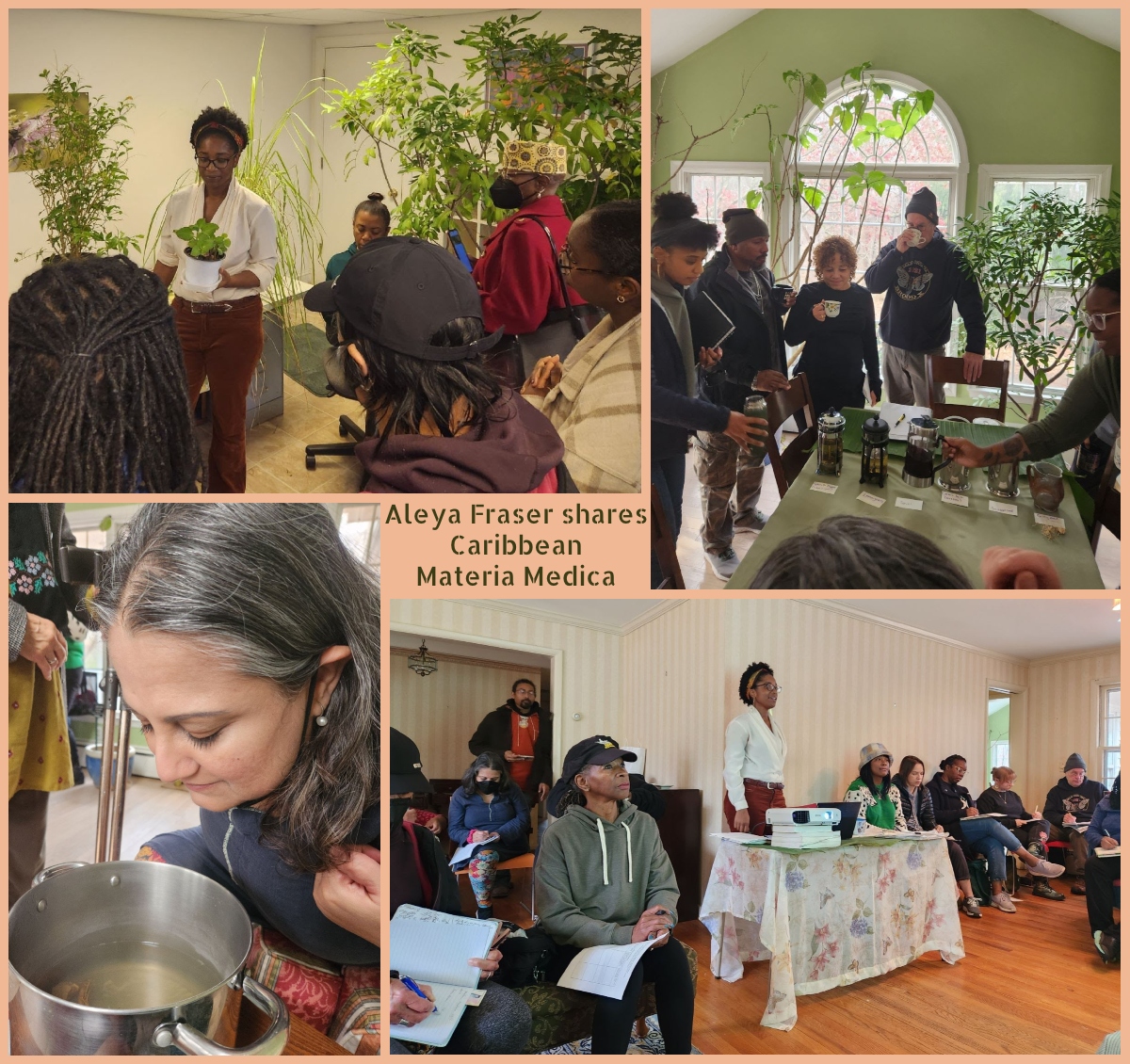
Under CEI’s stewardship, public events at the Green Farmacy Garden have for the first time been able to utilize the former Duke family home. Guest teacher ethnobotanist Aleya Fraser’s dynamic Caribbean Materia Medica workshop inspired us to explore the potential of the house’s diverse spaces. After a brief introduction to the largely dormant Garden, participants met tropical plants in Peggy’s studio (top left), sampled herbal infusions and an herbal steam in the sunroom (top right, bottom left), and took in a multimedia presentation in the living and dining rooms (bottom right):
A photographer for the Baltimore Sun joined us for yesterday’s mostly indoor Mushroom Log Inoculation workshop and we’re looking forward to seeing some of those images in an upcoming Howard County Times. A Sun reporter is working on a related piece to follow soon – if you’ve attended a workshop with us this year and would like to contribute to that article, please email me (gfg@cei.earth) your desired contact info to forward to the reporter!
Despite the freezes, a few species still show signs of life outside. From this angle we can see North American natives Yucca filamentosa in the foreground, bottom right; at photo center, Yaupon holly (Ilex vomitoria) on the right with the distant Southern Magnolia (Magnolia grandiflora) to its left; and Juniper (Juniperus communis) to the gazebo’s right in the image:
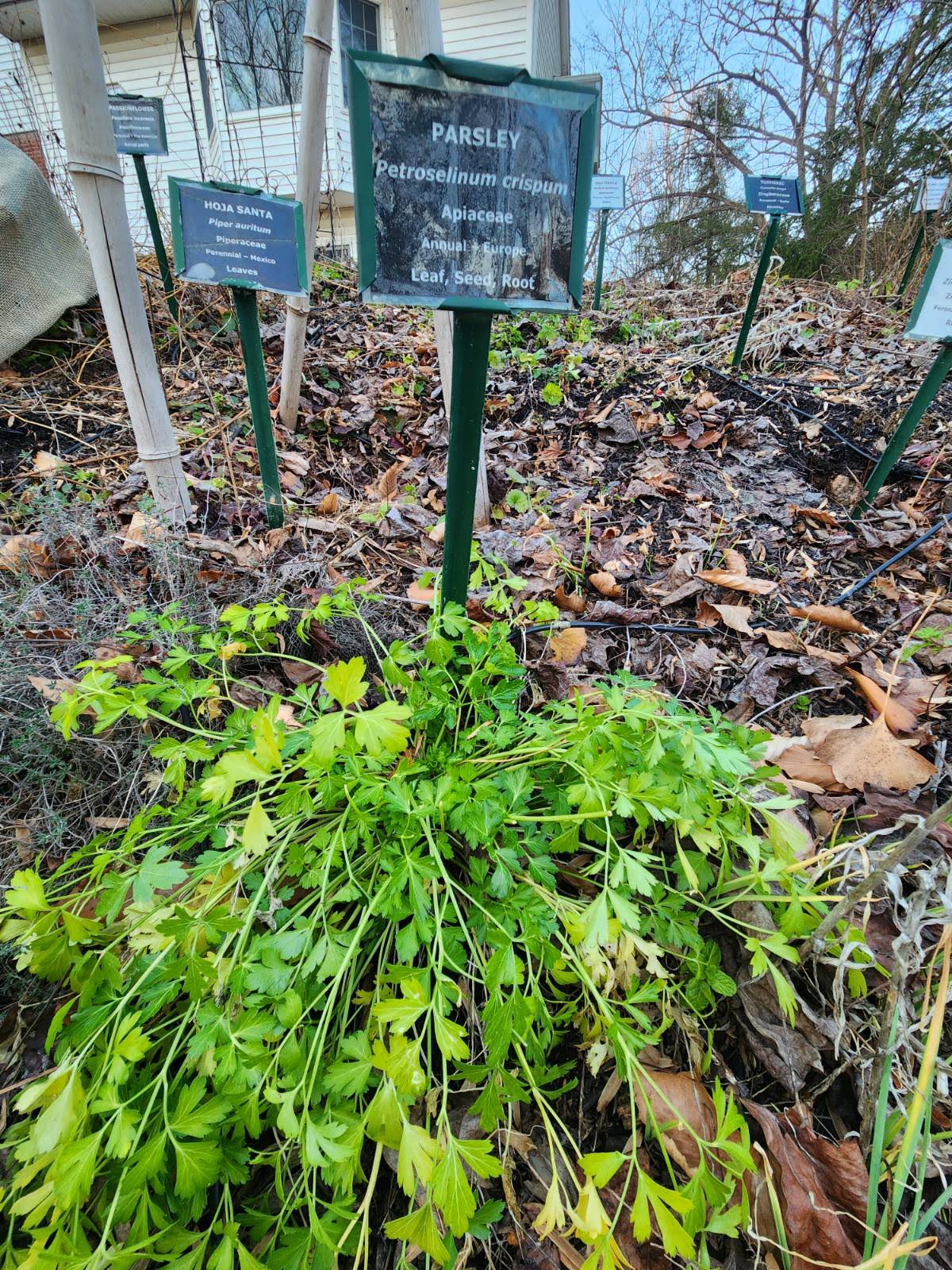
Above: left, Love-in-a-Mist (Nigella damascena, representing Black Seed, Nigella sativa) seedlings carpet the ground under their parents’ seed-heads; right, Parsley (Petroselinum crispum) droops and fades but persists in vibrant green.
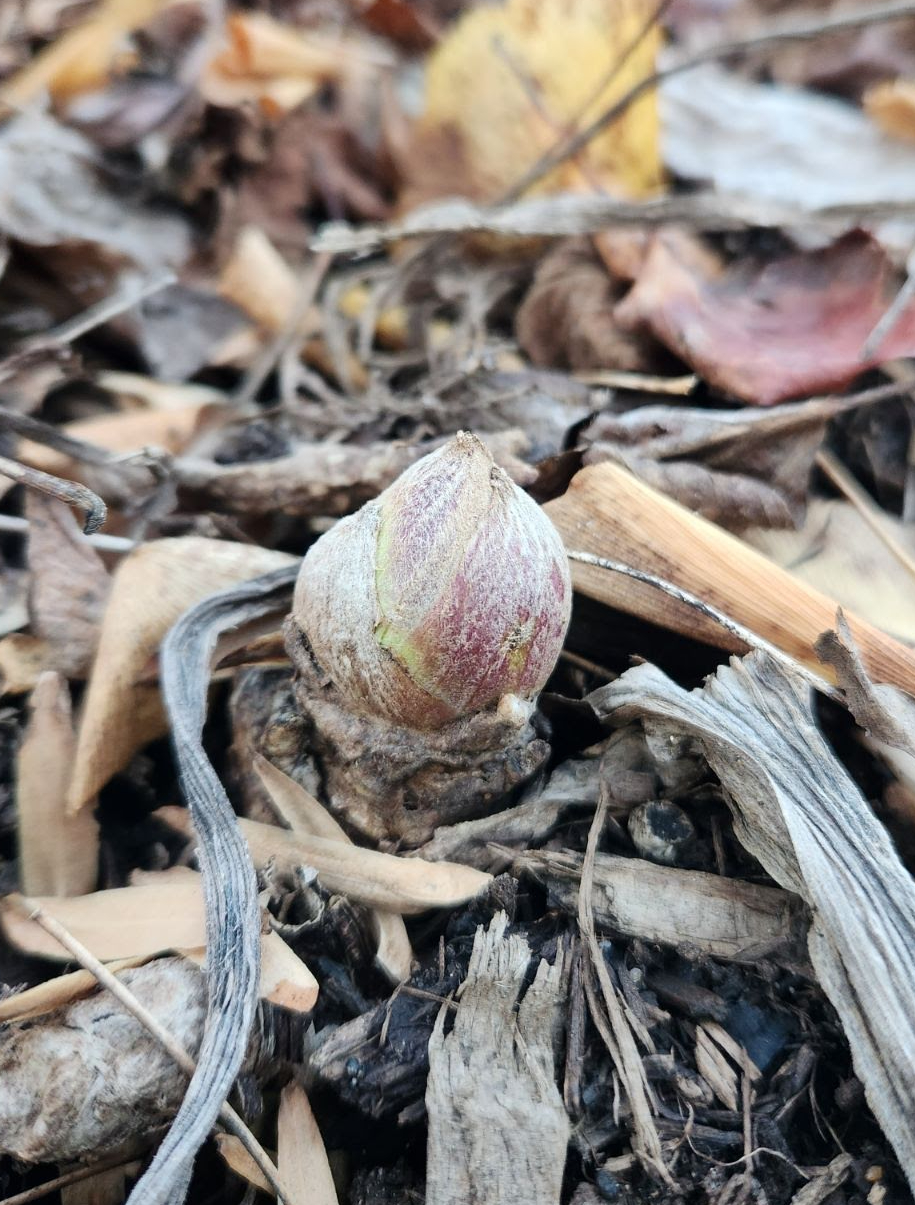
Below, counter-clockwise from top: Horsetail (Equisetum hyemale) at the Garden’s entrance; a Giant Butterbur (Petasites japonica) bud swelling – they will start blooming in January!; and my personal favorite garden nibble: garlic leaves, available year-round except for the driest few months.
Mullein (Verbascum thapsus) and Milk Thistle (Silybum marianum) are two of the rowdiest self-sowers in the garden. They love to germinate in the gravel of the garden stairs, where we mostly have to remove them. Sometimes they choose an appropriate spot to thrive in, like the Milk Thistle at bottom left that’s located itself only slightly left of the Aging plot for which it’s indicated, in front of some Motherwort (Leonurus cardiaca) growing rightfully in Menopause. Often Mullein refuses to thrive where its indicated so we have to leave a few in the rock walls where they go wild (bottom right):
We’ve currently got our Monthly Herbal Medicine-Making offering–Nourishing Infusions–and CEI’s ongoing Second Saturday Socials (winter rendition of Second Friday Fires) coming up on January 13, and anticipate hosting more community events over the winter, including our Eco-Game nights and Climate Cafes.
May the light of love and wonder be with you and your loved ones–human and beyond–this season, and we look forward to reconnecting with you in the New Year!