
Happy Lughnasad, dear Friends of The Green Farmacy Garden!
This Gaelic Festival marks the beginning of the harvest season and the midpoint between the Summer Solstice and Autumn Equinox: the very height of summer, and a celebration of the season’s abundance. Local tomatoes, summer squash, cucumbers, green beans, garlic, corn, and of course, peaches! are furnishing cookouts, stews, ragouts, sauces, and cobblers for both summer meals and winter preservation.
Honey bees (Apis mellifera) are still looking, but finding less to eat during the summer dearth, as the trees have all finished blooming and late blooming perennials haven’t fully flushed. Here in the Garden, their buzzing stopped me in my tracks as I approached the Jujube (Ziziphus jujuba), afraid I was going to step on a nest. I’ve read that honeybees visit and pollinate the native Passionflower (Passiflora incarnata), but I’ve never personally seen them. In the (hopefully temporary!) absence of the Devil’s Walking Stick (Aralia spinosa) they’re probably missing as much as I am, along with so many other pollinating insects, the Garden’s mainly offered assorted coneflowers til the Goldenrods (Solidago sp.) started popping this week.
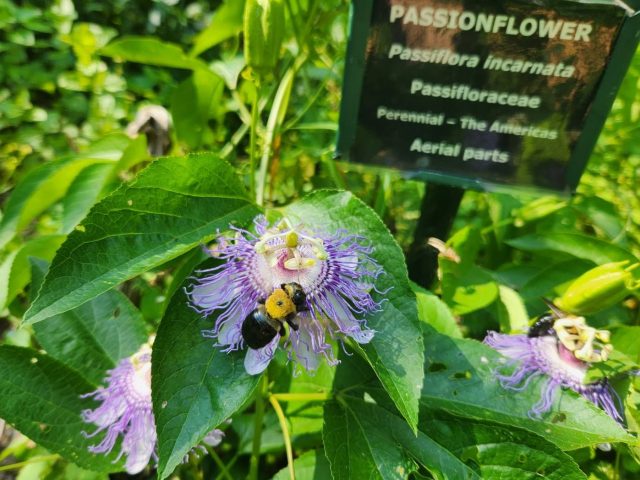
Carpenter Bees (Xylocarpa virginiana) like the one pictured above are the primary pollinators of the native Passionflower, which is currently ripening many smooth lime-green ovoid fruits larger than a chicken egg, called Maypop — when they’re ripe, the fruits will burst open when squeezed.

Last year, the native Prickly Ash (Zanthoxylum americanum) appeared to be the Spotted Lanternflies‘ (Lycorma delicatula, or SLF) favorite, (yes, there’s SLFs on our Grapes (Vitis sp.), but not as many as on the Prickly Ash) and they’re still all over it (see below, left), though not in the densities they’ve surged in other places you’ve likely seen in person or in photos. This year I noticed lots of adults on the Bai Zhi (technically the name of Angelica dahurica root as prepared and used in Traditional Chinese Medicine), as pictured above left. As you can see below right, the Angelica is unharmed. The Prickly Ash has also showed no signs of damage from this concentration of SLF feeding.
For those concerned about SLF, take heart in the research results out of Penn State looking “at the long-term impacts of feeding pressure on Northeastern hardwoods.. results suggest that we are unlikely to see big impacts on the growth of trees,” and this year’s showing that several widespread arthropod predators consume SLF in all life-stages, regardless whether they’ve been feeding on Tree of Heaven (Ailanthus altissima) or not. Look at those Spined Soldier Bugs (Podisus maculiventris) go!! In the predation chart from that study, included at the end of this post.
Also pictured above, top right, is a Blister Beetle (Epicauta sp.), a native insect I’d never heard of, which both contains and secretes a poisonous chemical, cantharidin, that can cause blistering, though it’s apparently also been used as a (sometimes fatal) aphrodisiac!!? Above middle right, a Japanese beetle (Popillia japonica) enjoys a Passionflower bloom, and bottom right a Crescent (Northern? Pearl?) butterfly (Phyciodes sp.) rests in the Oregano (Origanum vulgare).

Some lower drama delights, though still breathtaking to me, pictured below, clockwise from top left:
- New shoots erupt from under thick bark on the fallen, now nearly horizontal, Willow (Salix sp.) trunk in Angina;
- I keep finding little piles of smooth, shiny, gray Somethings in Goldenseal (Hydrastis canadensis) leaves under where the berries would’ve been, and have become convinced they’re seeds – which we can collect to share and propagate!;
- I couldn’t find online any reference or examples of other Witch Hazel (Hamamelis virginiana) fruits showing this spiky phenomenon.. you can see surrounding the spiky one featured are several normal fruits — any information would be welcome!;
- Coral-pink Merulius (Phlebia incarnata) fruiting on a Log Erosion Barrier in the Garden, alongside its common companion Stereum ostrea;
- Blackberry Lilies (Iris domestica), used medicinally in China, Korea, Japan, Vietnam, Indonesia, Nepal, Malaysia, the Philippines for a variety of issues, standing tall (for once.. they often flop over) in full bloom;
- Elderberries (Sambucus canadensis) ready to harvest.

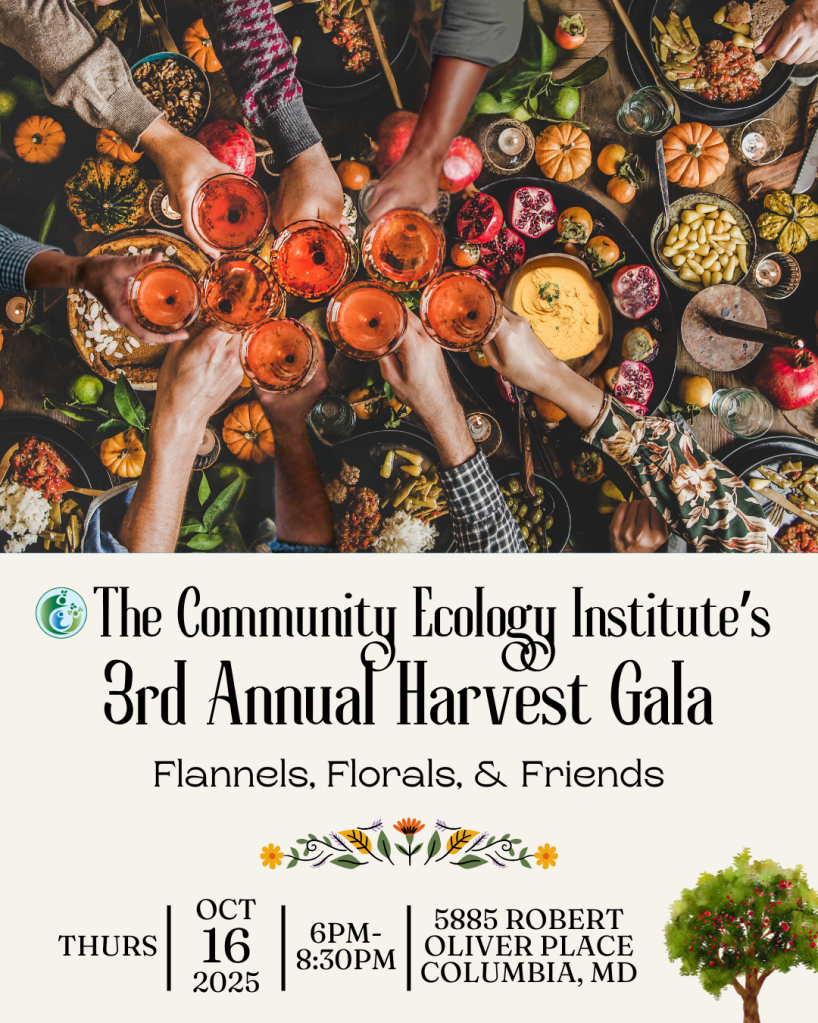
Our annual Harvest Gala is fast approaching!
Join us on Thursday, October 16 at the Meeting House in Columbia from 6-8:30pm for live music by Miss Moon Rising, flavorful fare from Koshary Corner, a sensational silent auction, and fun community building opportunities.
Get your tickets here!
Learn about sponsoring the gala here.
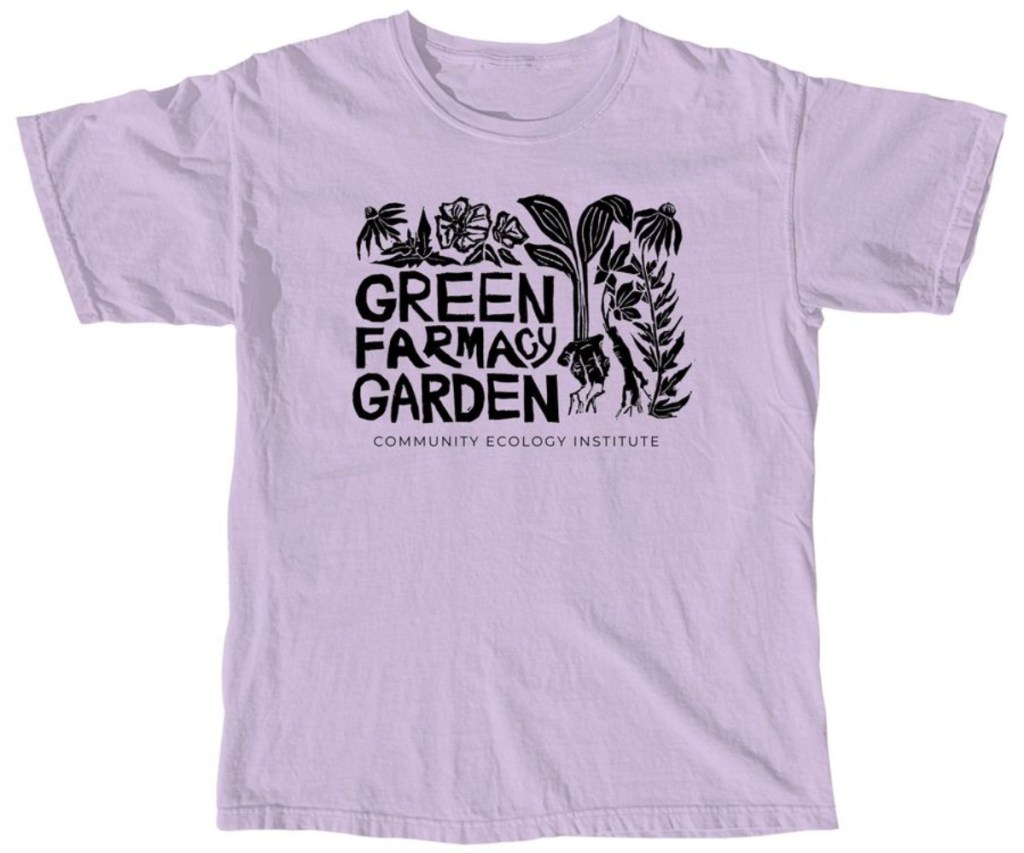
Along with an assortment of CEI fundraiser merch, we’ve reopened ordering for the Green Farmacy Garden t-shirts featuring this block print design by local artist Nikita Yogaraj. Peruse all the options of totes & garments
We’re grateful for your support, and your collaboration in our efforts to cultivate communities where people and nature thrive together!
As always, our Public Events page offers more upcoming events at the GFG, and you can explore CEI’s core Programs and full event calendar on the website. We look forward to sharing the Garden with you! -Veri for The Green Farmacy Garden team

All images by Veri Tas.


 The Green Farmacy Garden, care of CEI