Happy Spring, dear friends of The Green Farmacy Garden!
‘Tis the season.. to learn what your plant relatives look like when first emerging! I’m always emphasizing the importance of being able to recognize a plant in any stage of its life cycle, as part of my Foraging classes. Many of the plants highlighted below aren’t candidates for foraging, but the identification practices apply to all plants, and if you Are wanting to forage, it’s just as important to know what’s out there that can harm you as what can help you! Without being distracted by the other plants growing close to or in between (we’ve got Goutweed (Aegopodium podagraria), Ground Elder (Glechoma hederacea), and Disappointment Berry (Potentilla indica) and more visible in some of these shots), here are some of the plants popping up around the Garden & grounds. Spiraling in, clockwise from bottom left:
- Veratrum viride, the toxic and stunningly gorgeous Corn-Lily, shoots emerging along the stream. Note the grooves running along the length of the leaf, indicating this plant’s parallel vein pattern, far less common in the plant world than your stereotypical netted venation system.
- Symplocarpus foetida, Eastern Skunk Cabbage, looks pretty similar to the Corn-Lily at this emerging shoot stage, but note the absence of those (now-)vertical grooves. Skunk Cabbage doesn’t have parallel venation.
- Our tropical Physic nut (Jatropha curcas) pushes out new leaves after a couple months in the sun room without leaves.
- Young leaves of the (potentially) fatally toxic Colchicum autumnale, Autumn Crocus showing substantial evidence of herbivory! It keeps mystifying me when our local wildlife browse on deadly plants in the garden but don’t turn up dead – hopefully it’s small enough doses that they are unharmed.
- Lacy early foliage of Queen Anne’s Lace, the wild Daucus carota, from which our common carrots were domesticated. The deadly Poison Hemlock, Conium maculatum, has similar foliage and can be mistaken for this plant.
- Sweetgrass, Hierochloe odorata, the main character of Robin Wall Kimmerer’s opus of plant relating Braiding Sweetgrass. To align with the traditional ecological knowledge of many indigenous peoples with millenia of relating with this species, as well as the scientific research Kimmerer supervised which found “sweetgrass flourishes when it’s harvested and declines when it is not,” this patch needs to be harvested this year. We will move some to the agroecological demonstration wetland meadow we’re implementing this year, and will share more as appropriate for the Garden population with local Indigenous community members on request!
- Borage, Borago officinalis, and other seedlings of herbs indicted in various Garden plots pop up in seed-starting trays, pictured here hardening off on the balcony.
- Solstice Wort/ St. John’s Wort, Hypericum sp., shows a distinctive red coloration to the youngest leaves and around the edges of older leaves, which are small, ovoid, and relatively flat, and occur in pairs on either side of the stem.
- Rattlesnake Master, Eryngium yuccifolium, is easy to distinguish from its namesake, Yucca, at this stage, because Yuccas are evergreen and the leaves of young plants are far more narrow relative to length. Even at this stage, the blue-green hue of the Rattlesnake Master’s leaves is notable, the Epicuticular wax that coats its leaves is visible, and the bristly teeth along the leaves’ margins are distinct.
- Young Achillea millefolium, Yarrow, show the recognizable fernlike foliage, characterized by bipinnate (twice divided) or tripinnate (thrice-divided) leaves with an overall lanceolate (lance-like) shape.

Other plants are already (or still, in the case of Citrus) blooming. Below, spiraling in, clockwise from bottom left:
- This Petasites Japonica, Giant Butterbur, flower is at its peak
- Jaborundi, Pilocarpus jaborandi, a seasonal denizen of the Glaucoma plot, blooms in the sun room
- Magnolia liliifera, Tulip Magnolia, just opening next to the house
- Yellowroot, Xanthorhiza simplicissima, sports tiny buds at the same time its leaves burst out
- The dainty woodland Twinleaf, Jeffersonia diphylla, also blooms as it breaks ground
- Tussilago farfara, Coltsfoot, opens prolific dandelion-like sun-yellow flowers before producing any leaves
- Citrus x sinensis, our new Orange tree, fills the basement studio with intoxicating sweetness from just a few blooms, at least double the size of the Lemon, Citrus x limon, flowers we’re used to
- Petasites japonica, Giant Butterbur, buds in this stage are a common Japanese “mountain food” and spring tonic called Fukinoto
- Mertensia virginica, Virginia Bluebells, prepare to open their heavenly blue flowers
- Sanguinaria canadensis, Bloodroot, blooms above its ingle leaf preparing to unfurl

Our Public Events are on the up-swing in April: we’re hosting 2025’s first Community Day, in honor of Earth Day; and April’s Volunteer Day focuses on important Garden care. As always, you can explore CEI’s core Programs and full event calendar on the website.
Exciting CEI News of the hour:
We’re Hiring an Agroecology Program Manager! Justin leaves big shoes to fill, but we know the right new team member will find us and we’re excited for the collaborations to come!

We look forward to sharing the Garden with you! -Veri for The Green Farmacy Garden team
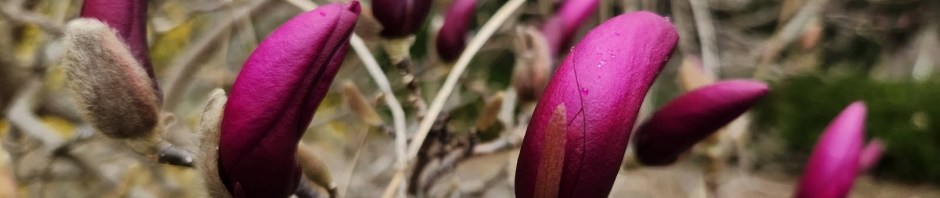
All photos courtesy of Veri Tas. Banner image shows Magnolia liliifera buds in March


 The Green Farmacy Garden, care of CEI