
Happy September, dear friends of The Green Farmacy Garden!
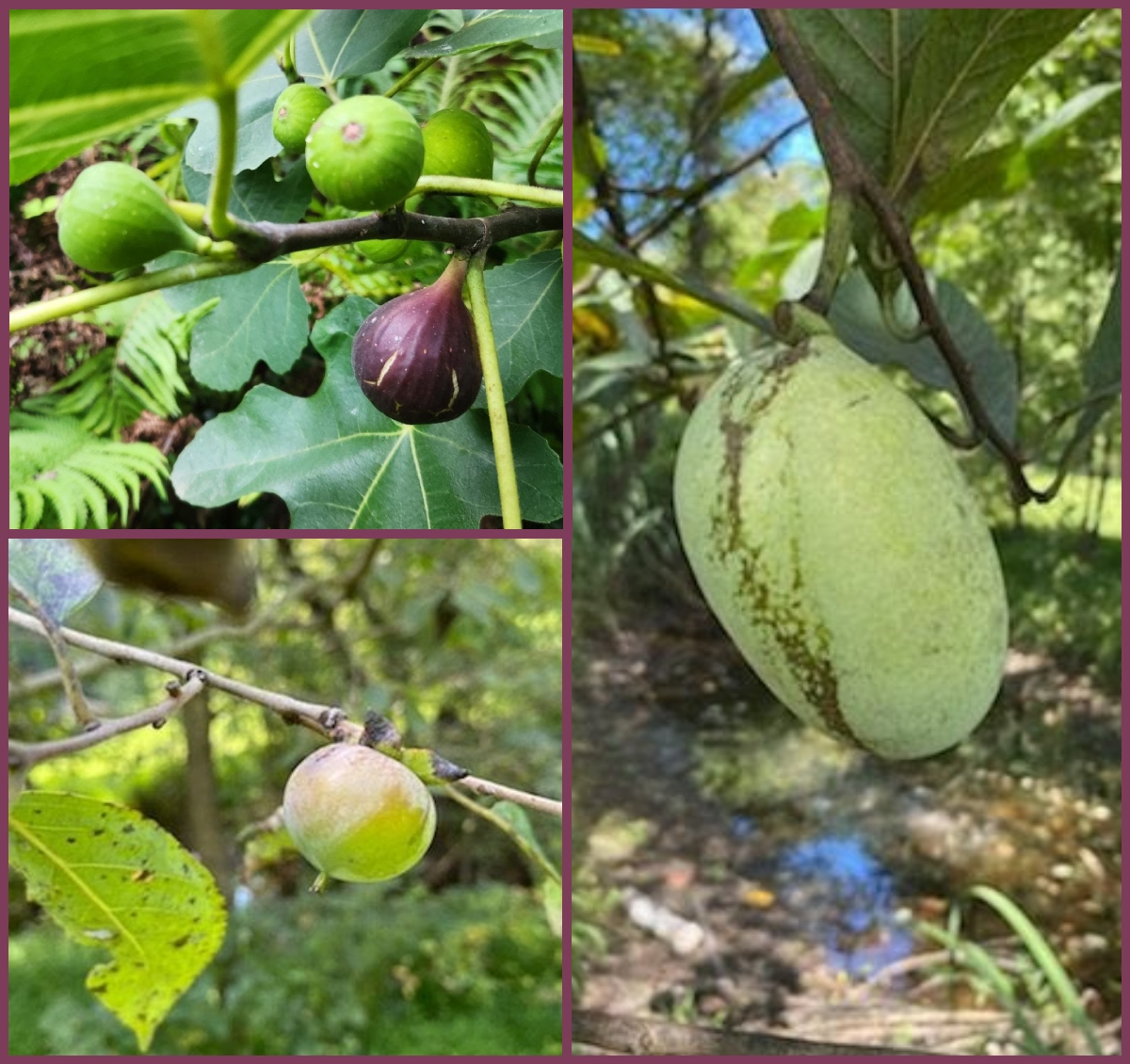
And, just like that! Now we’re winding down summer and, like the plants and animals, beginning to shore up for winter. We’re enjoying ripe figs (Ficus sp) (below, top left) and watching persimmons (Diospyros virginiana) (bottom left) and passionfruits (Passiflora incarnata) develop. Most excited for the imminent Peterson Pawpaws (Asimina triloba) (bottom right) maturing on trees generously donated years ago by friend of the Garden Mike Schenk!
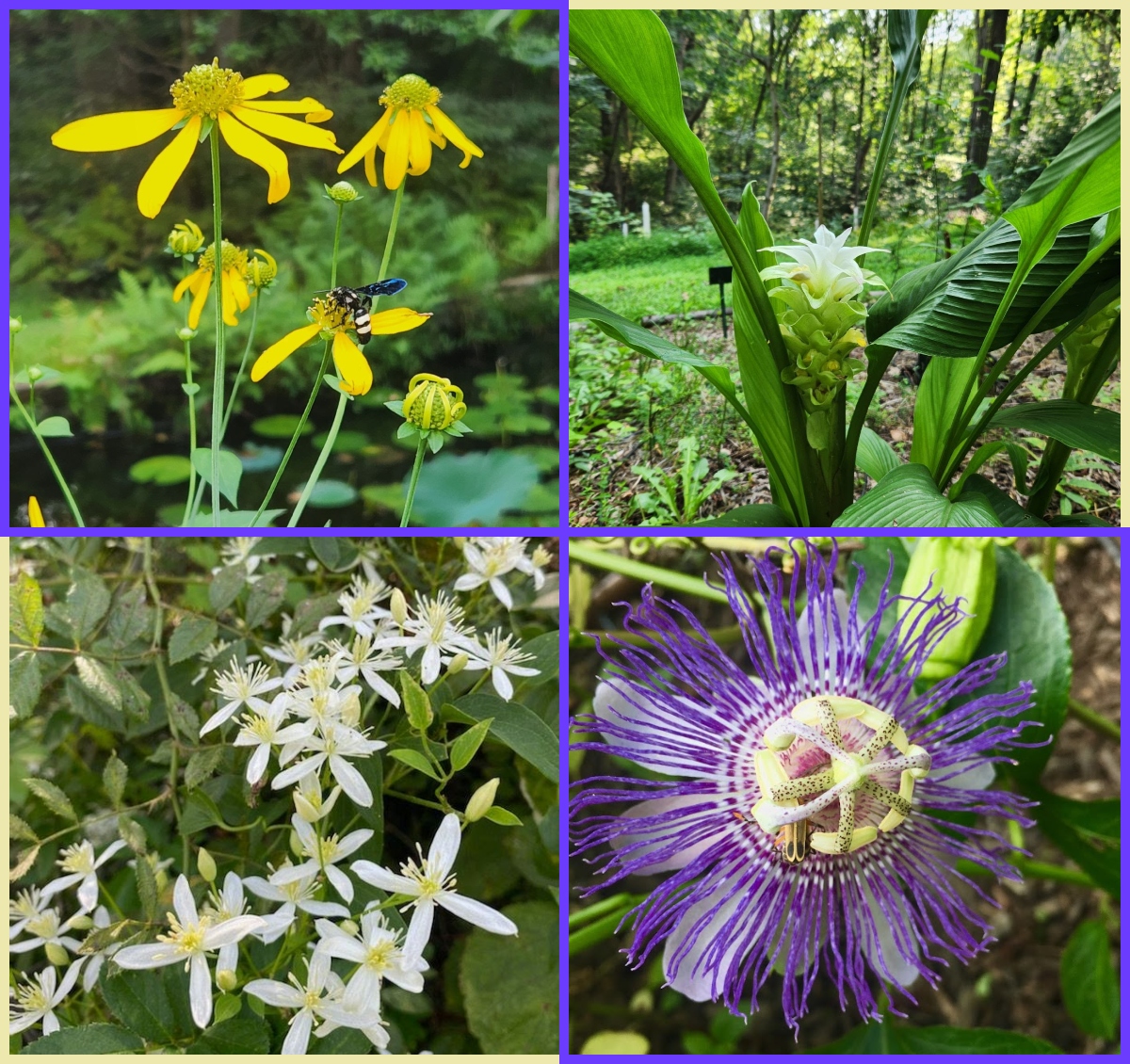
Garden show, of course, is down to the late-bloomers like Goldenrod (Solidago spp), Sochan (Rudbeckia laciniata) (below, top left) and other asters, punctuated here and there by mind-bending Passionflowers (Passiflora incarnata) (bottom right), and the Turmerics (Curcuma longa) (below, top right) old enough to bloom! Beyond the Garden, rambling over bamboo, mulberry, bittersweet, and more along the driveway where it’s hard to reach and manages to access the sun it needs, the heavenly sweet-scented Asian-native Sweet Autumn Clematis (Clematis terniflora) (bottom left) has also begun its reproductive riot.
The heron mentioned last month (probably) has been returning to stalk the pond, and we’re exploring options to deter them.. though I adore seeing them, and their medicine has blessed all the staff here at times we quite needed it, we want to protect the fish and frogs our pond supports. We’d welcome contributions of expertise or materials from anyone who’s successfully accomplished a mission like this before!
Other wildlife we’ve enjoyed spotting include the local wild turkey (Meleagris gallopavo) flock passing through (below, top right), an American Toad (Anaxyrus sp) (below, top left), a grasshopper (bottom left)? I’m unable to identify, and a flashy insect.. maybe a Net-Winged Beetle (Calopteron sp)? (bottom right). Hopefully our “Bug Diversity” workshop later this month will help me (and others) with these IDs! And thanks to our Outreach and Restoration Grant from Chesapeake Bay Trust, we’ve secured several wildlife cameras that we hope will soon enable us to provide you with better quality images of more faunal diversity!

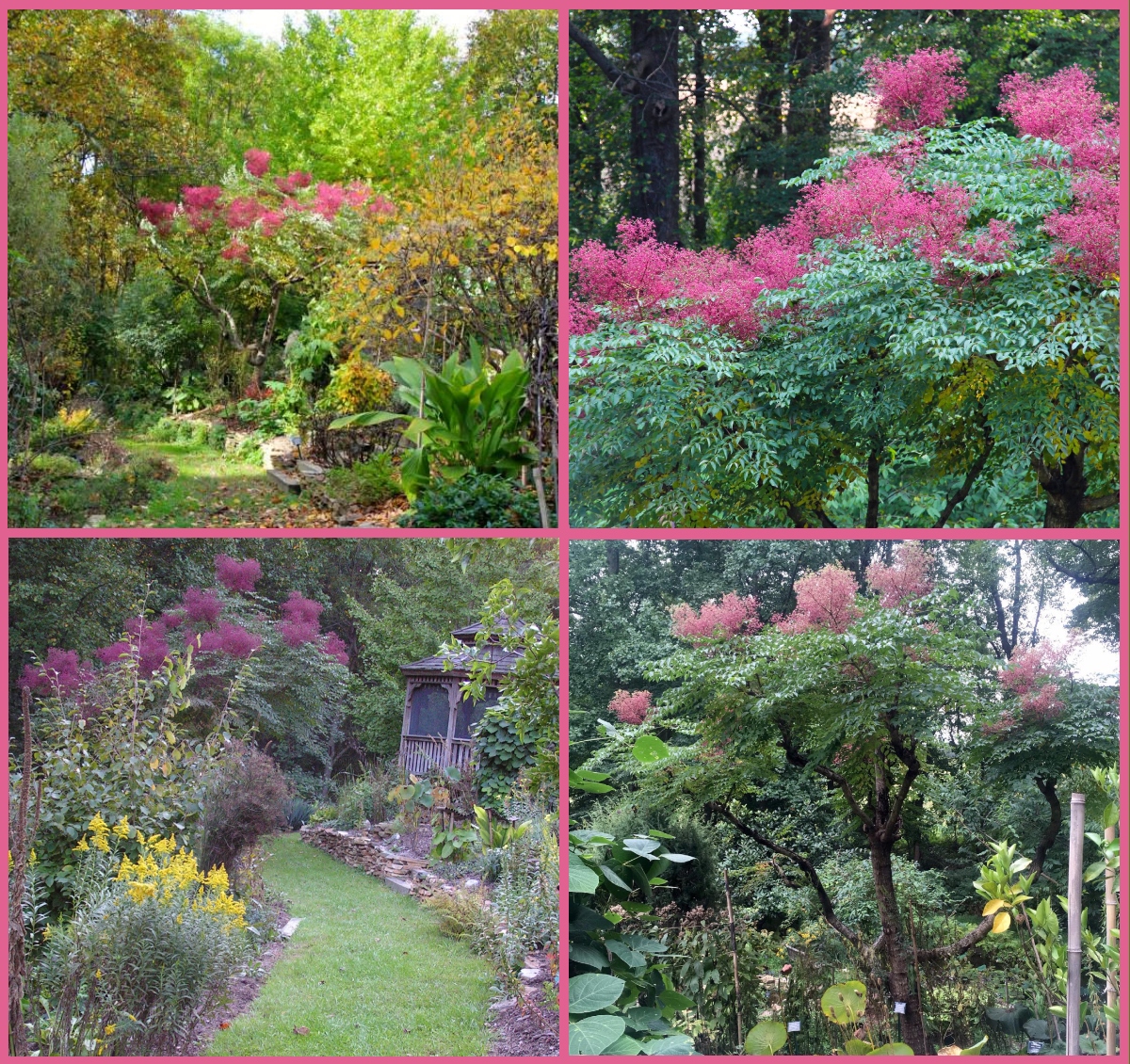
We sadly watched the leaves and flowers wilt and brown on branch after branch of the stunning Devil’s Walking Stick (Aralia spinosa), who’d provided a central sculptural statement by the stairs in Terrace C and an all-you-can-eat buffet for buzzing multitudes of pollinators for many years. Pictured below in 2014 (top left), 2016 (top right), 2017 (bottom left) and having begun its decline in 2019 (bottom right).
Research confirms my own suspicion based on observing wild populations that this species tends to form colonies of straight, largely branchless trunks. Plants with a colonizing habit, that spread by underground runners (rhizomes), are among the most challenging to deal with in the Garden: not only are they hard to keep track of and hard to remove, digging them out can cause disruption to other plants’ roots and to the graded terrace surface, resulting in increased erosion risk; as well as adding pressure to the aging rock walls holding up half of each Terrace! So I’ve long been somewhat awestruck with gratitude for the unique growth habit of our Aralia spinosa specimen, with its bold branching and non-evident root spreading.
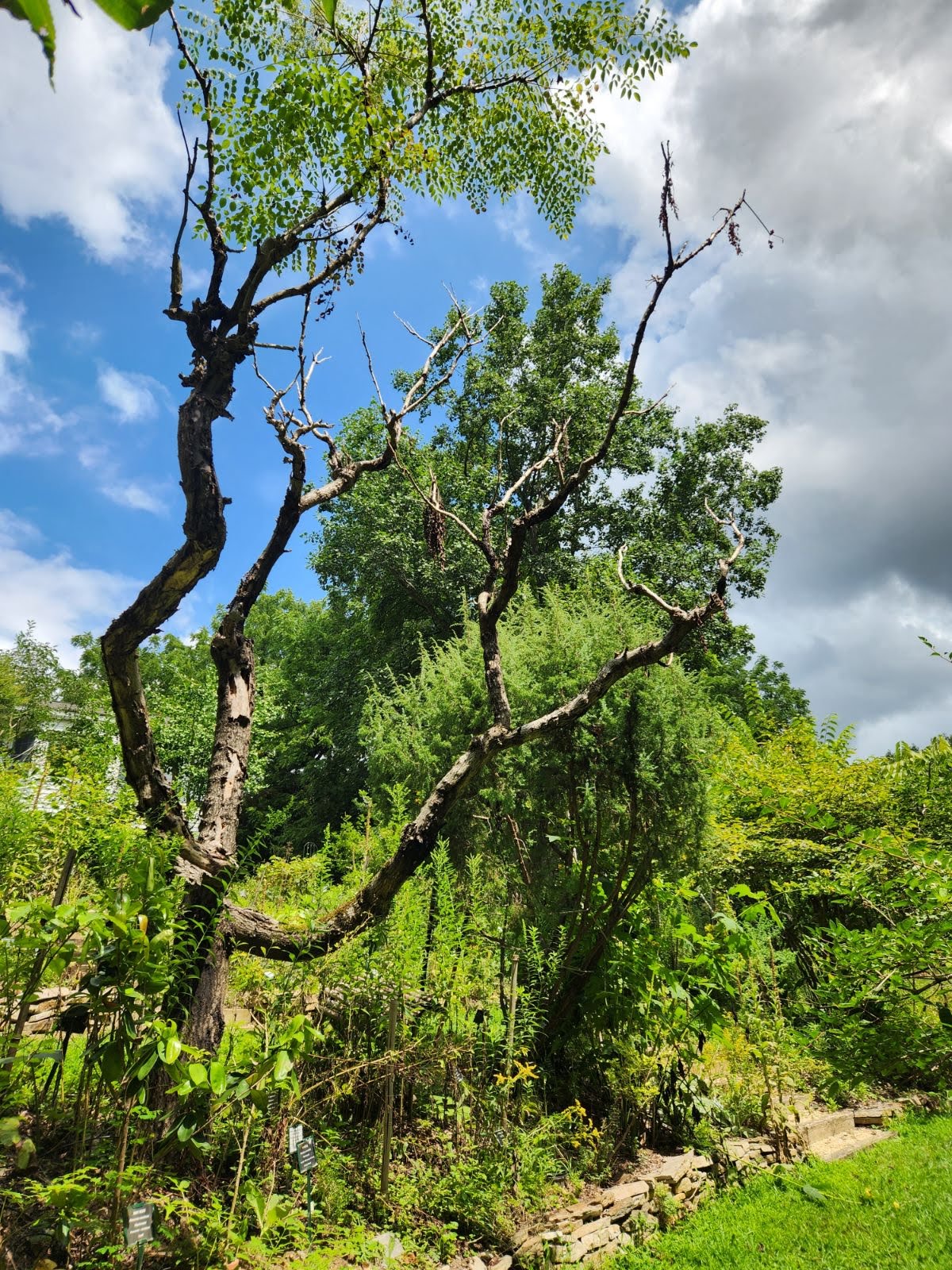
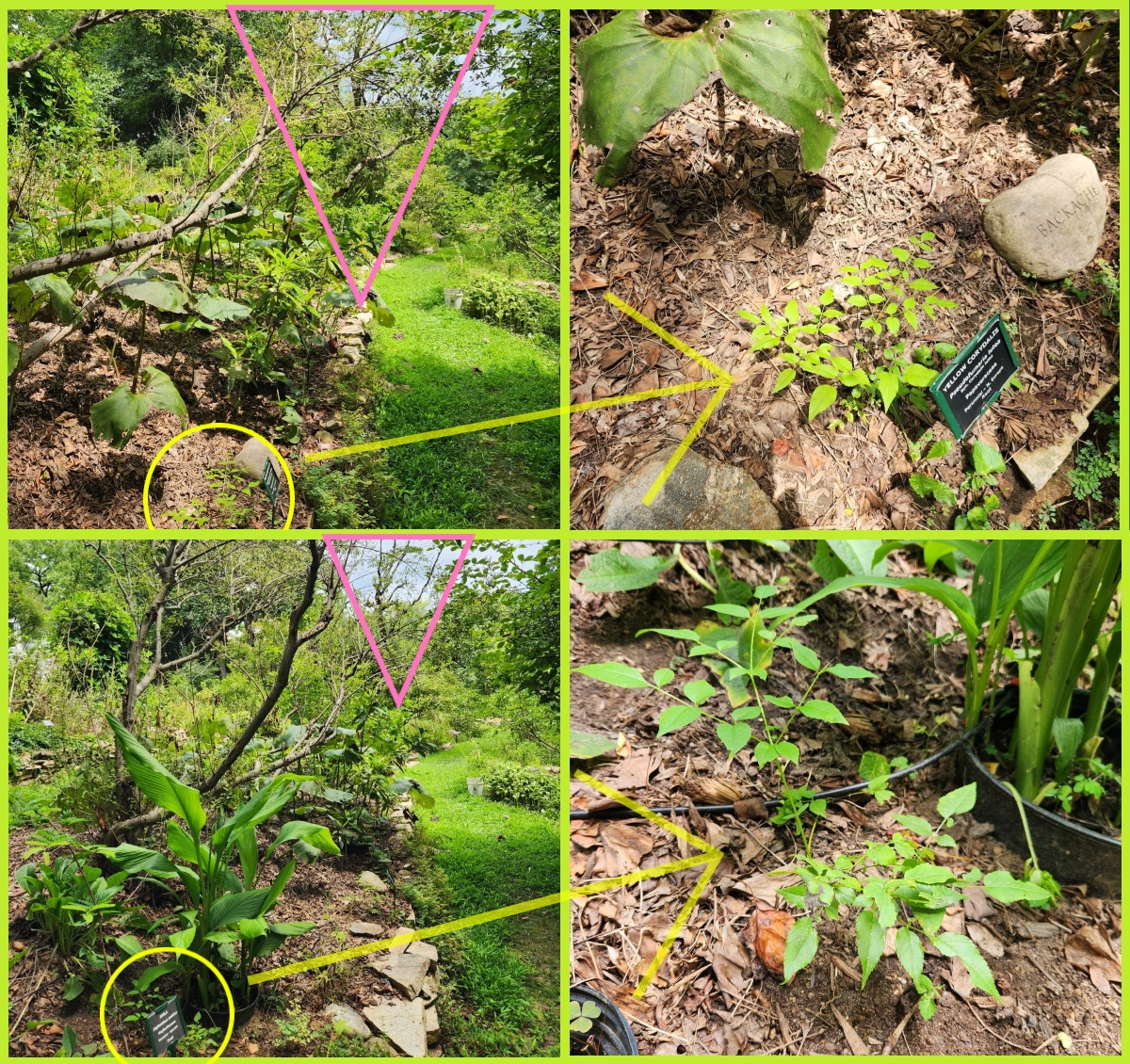
When I joined The Green Farmacy Garden team in 2019, the Prickly Ash (Zanthoxylum americanum) tree that used to grow in Toothache alongside the Devil’s Walking Stick (and shade the Giant Butterbur (Petasites japonicus) in the adjacent Headache plot) had recently died back and only remained as a stump, but since then we’ve watched many sprouts come up throughout the plots and currently, one seems poised to replace the former specimen. So when the last leaves of the Aralia (below) withered, I went around checking all the shoots in the area to ensure they were Prickly Ash and not Devil’s Walking Stick.
But to my utter delight, I discovered that many ARE in fact Aralia shoots popping up, from quite distant roots. I found a few amidst the Butterbur, but then was amazed to find the one pictured below (top left and right) under the Willow (Salix integra?) 3 plots down in Bursitis.. and then the one past the Willow (below, bottom left and right), between Turmeric (Curcuma longa) and Amla (Phyllanthus emblica) moving on towards Bronchitis! The original Aralia is highlighted in pink below, ever more distant!
If you zoom in, you might be able to see at top right the clinching characteristic letting me know these are Aralia and not Zanthoxylum shoots. Prickly Ash has pinnately compound leaves (leaflets are arranged around the leaf-stalk in a pattern reminiscent of a feather), while Devil’s Walking Stick has the largest leaf of any temperate tree in the continental U.S. (according to Wikipedia article), up to 4′ long! and with a multiply compound structure, consisting of pinnately arranged leaflets which themselves are composed of pinnately arranged leaflets.
Please explore our public event offerings to touch and vibe with this amazing plant yourself, and engage in whatever educational opportunities inspire you!
In addition to the offerings at GFG, CEI hosts weekly Plant and Produce sales at Freetown Farm on Saturdays, offers monthly New to CEI tours there, and operates a variety of experiential education programs, which you can explore on the Programs page of the website. The full CEI event calendar is available on the website.
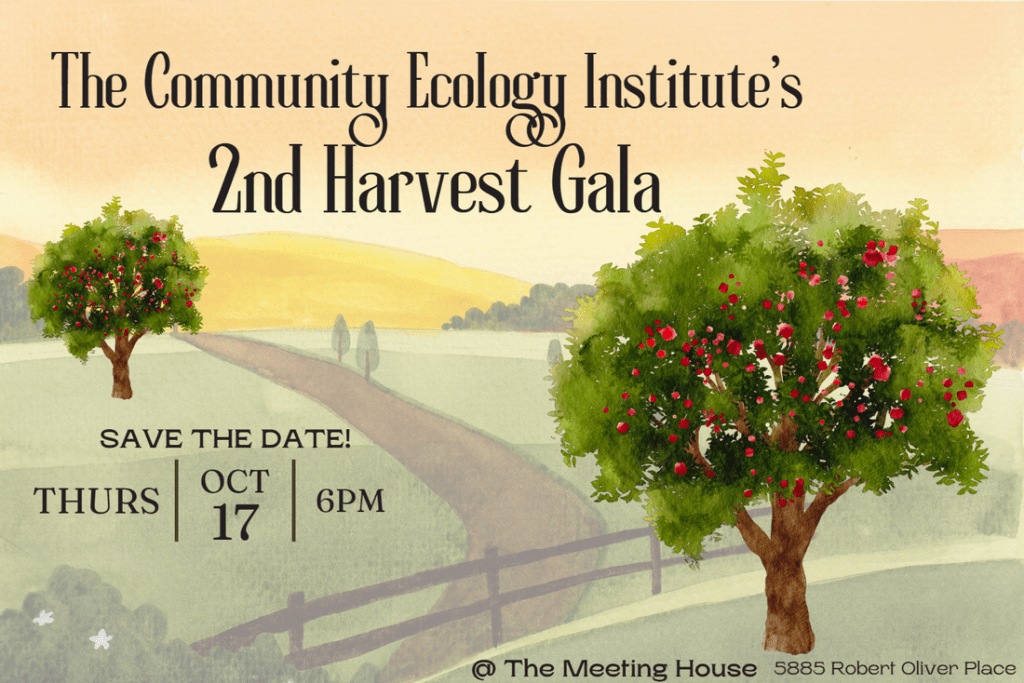
Tickets are selling fast for our October 17 annual Harvest Gala fund-raising event, but our new venue can accommodate quite a crowd so there’s plenty of room for you and your crew. Come on out to meet, mingle, and nosh with a lot of our staff, learn about the various program offerings, bid on silent auction items, enjoy musical entertainment, and get a big picture sense of the impact CEI’s work makes in our community of place.
My best, Veri
Pawpaw, persimmon, clematis, turkey photos by Annie-Sophie Simard; mantis and spider by Matthew Jacobsen; Io moth by Julie Biedrzycki; all others by Veri Tas.


 The Green Farmacy Garden, care of CEI