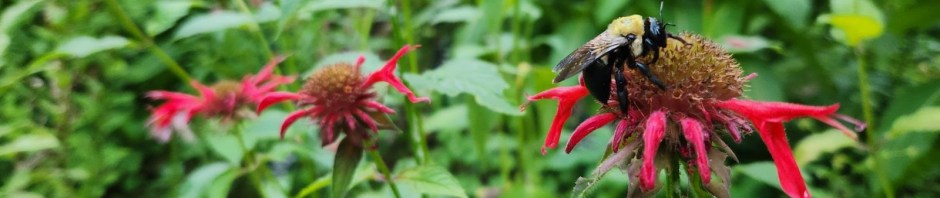
Are you staying cool this summer, dear Friends of The Green Farmacy Garden? (or warm this winter, for our friends in the Southern hemisphere!)
July brought a couple rains, and the record-breaking sweltering heat relented to more normal height-of-summer temps, but these recent weather extremes are really putting the plants through their paces! Despite the challenges to local flora, we’ve enjoyed many encounters with the biodiversity the Green Farmacy Garden property and region hosts and supports. We’re grateful for our bird-enthusiast friend Terri adding The Green Farmacy Garden as an eBird hotspot, so everyone can peruse the many bird species observed here!
Bunnies and groundhogs have been much more visible than many previous years, though we’ve seen fewer snakes. Annie-Sophie had to chase off a Great Blue Heron (Ardea herodias, below) who was gorging on frogs in the pond, and Veri and friend surprised a doe in the woods who trumpeted at us repeatedly while paralleling our path. Wonder if she was calling a fawn, or warning us to keep distance?

Here’s a beautiful example of why we NEVER pull (weed) a plant we can’t identify from Jim Duke’s garden.. none of the gardeners recognized the plant below (left), which looks very similar to Ginger (Zingiber officinale) but has unscented foliage, and is growing unprotected from the ground unlike our Ginger pots that all have to overwinter indoors. An internet resource suggested Myoga (Zingiber mioga), or Japanese Hardy Ginger, which jogged a faint memory for me of having brought some rhizomes of an exciting plant from local textile artist/ weaving legend Louise B. Wheatley‘s garden that I in no way expected to take. Looking up Myoga, I got excited and decided that was likely our plant, and then a few days later noticed this bloom (below, right), which clinched the ID. The young shoots and flower buds of Myoga are used culinarily, and I can’t wait to try them as the patch continues to flourish! I planted them in the Cancer plot, because the plant and its constituents have been researched for anti carcinogenic properties.


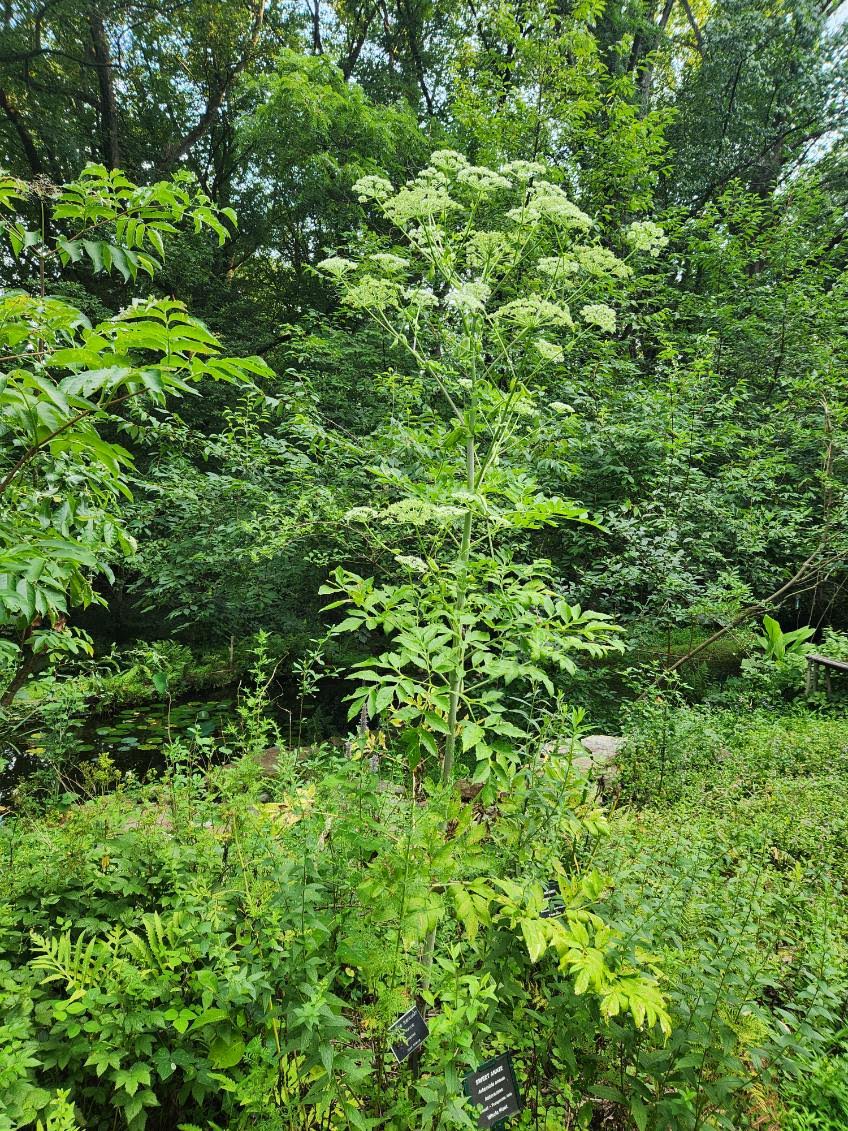
One of the most impressive biennials that self-sows in the Garden is Bai Zhi (Angelica dahurica), an herb with its own Traditional Chinese Medicine uses that is mainly grown in the GFG to represent Dong Quai (Angelica sinensis), more because of aesthetic similarities than medicinal application. This plant seeds so abundantly that I began dead-heading it aggressively a couple seasons back, but then we missed a year with an impressive (I mean they probably clear 8′ tall, despite the internet telling me 1-2 meters) specimen and I was afraid I’d damaged the genetics, so very relieved and joyful with the couple stunners we’ve got this year. Watching their new axial leaves uncurl from the sheath of an older leaf (below, top left) is one of my favorite annual delights along with the dew on new Lady’s Mantle (Alchemilla mollis) leaves and the emergence of baby Mayapple (Podophyllum peltatum) shoots that look like button mushrooms.
Below top right is the season’s tallest Bai Zhi, and at bottom, near frame-center is a Black Swallowtail (Papilio polyxenes) caterpillar chowing down on its blooms.


We’ve always got a stunning array of insects visiting the diverse plants at the garden, though this year there’s been less in-your-face butterfly predation as our incredible venerable Devil’s Walking Stick (Aralia spinosa) seems to have reached the end of its lifespan. Its blooms attracted a buzzing swarm of pollinators each year, and one year Bald-Faced Hornets (Dilochovespula maculata) were just picking off butterflies right and left as they nectared up there. We had a [very] few Spotted Lanternfly (Lycorma delicatula) nymphs on the Grape vines (Vitis sp.) earlier this season; and we’ve seen a few live adults scattered about, almost as many adult remains, and plenty of exuviae (shed skins of nymphal stages); but last week I came across the densest cluster (below, top left) I’ve yet seen onsite, chilling on our Prickly Ash (Zanthoxylum americanum).
** non-party-line interlude! If you’d feel better with “permission” to stop killing bugs, and training kids to kill bugs, check out this humane piece by Maryland’s “Humane Gardener” Nancy Lawson, this summary (or there’s plenty of other summarizing articles, and the paper itself) of the Penn State research project whose lead author said “if you’re a homeowner and you have large trees on your property and you have lanternflies on them, I don’t think you should worry about it.” and “Our study is the first to look at the long-term impacts of feeding pressure on northeastern hardwoods, and our results suggest that we are unlikely to see big impacts on the growth of trees.” There’s also a lot of interesting discussion here (pretty far downthread, tbh) among mostly amateur naturalists, if you’ve got a lot of time to read. You can also keep your own eyes peeled for dead lanternflies or those being eaten by predators, or check out this article on who’s eating them, and the iNaturalist collection of public observations.
*NB: I’m not willing to moderate a flame war, or any debate on the subject, here, really => comment submissions on the whiny-outraged-you’re wrong spectrum won’t be approved. There’s a whole wide internet where you can state your own beliefs or find folks to argue with, including some of the links above. **
Some other insects spotted this month include, below, clockwise from top right: Spiny Assassin bug nymph (Sinea sp.) on Anise Hyssop (Agastache foeniculum); Luna moth (Actias luna) hind wing pair found in grass along the woods; Bug eggs I find every year on Spearmint (Mentha spicata) — the closest I’ve been able to get is Family Coreidae (Leaf-Footed Bugs)

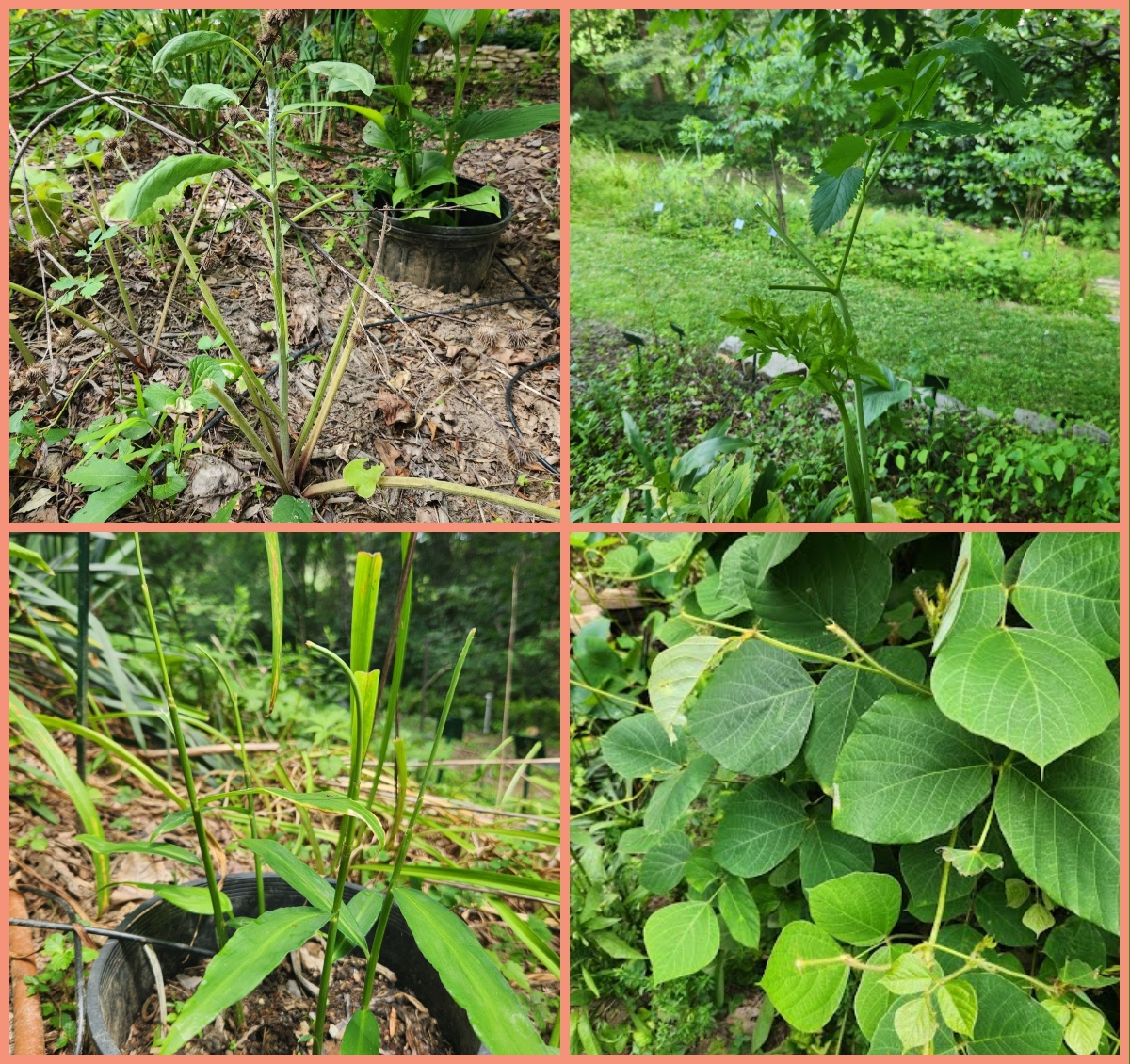
For all of you who eagerly clicked here for the latest on who’s getting hardest hit by megafauna herbivory (lol) the update is several natives whose status I know from their location in the Garden but whose actual identity I wasn’t able to confirm for this publication, and plenty of exotics. Below, clockwise from top right: Burdock (Arctium sp.), Bai Zhi (Angelica dahurica), Kudzu (Pueraria sp.), and Ginger (Zingiber officinale).
In these shots you can see nibbled stalks of, left, native Dogbane (Apocynum cannabinum) and non-native Mimosa/ Silktree (Albizia julibrissin) suckers; right, native Pinkroot (Spigelia marilandica) and non-native Valerian (Valeriana officinalis).

As always, please explore our public event offerings to experience the intrigue in person!
In addition to the offerings at GFG, CEI hosts weekly Plant and Produce sales at Freetown Farm on Saturdays, offers monthly New to CEI tours there, and operates a variety of experiential education programs, which you can explore on the Programs page of the website. To celebrate Freetown Farm’s 5th Birthday, we’re hosting a “Food by Freetown” event featuring a menu prepared with ingredients grown onsite, with a screening of the film “Common Ground” on August 22. The full CEI event calendar is available on the website.
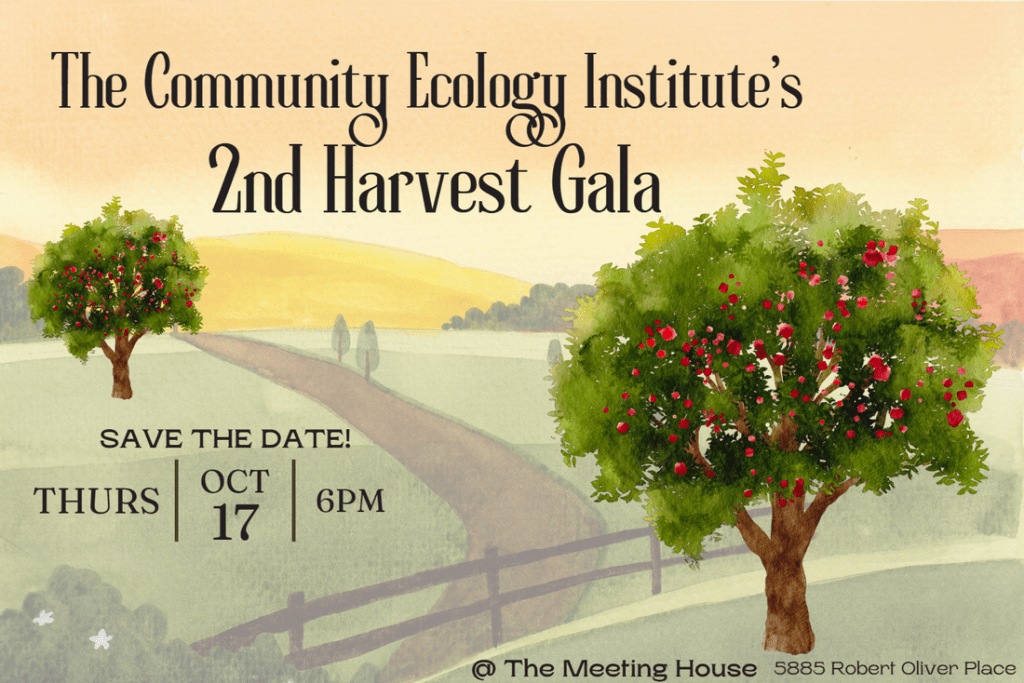
Once again, if it’s within your means, we’d love for you to join us for our October 17 annual Harvest Gala fund-raising event, where you can meet, mingle, and nosh with a lot of our staff, learn about the various program offerings, bid on silent auction items, enjoy musical entertainment, and get a big picture sense of the impact CEI’s work makes in our community of place.
My best, Veri
All photos the creative works of Veri Tas, except Heron and Myoga flower by Annie-Sophie Simard


 The Green Farmacy Garden, care of CEI